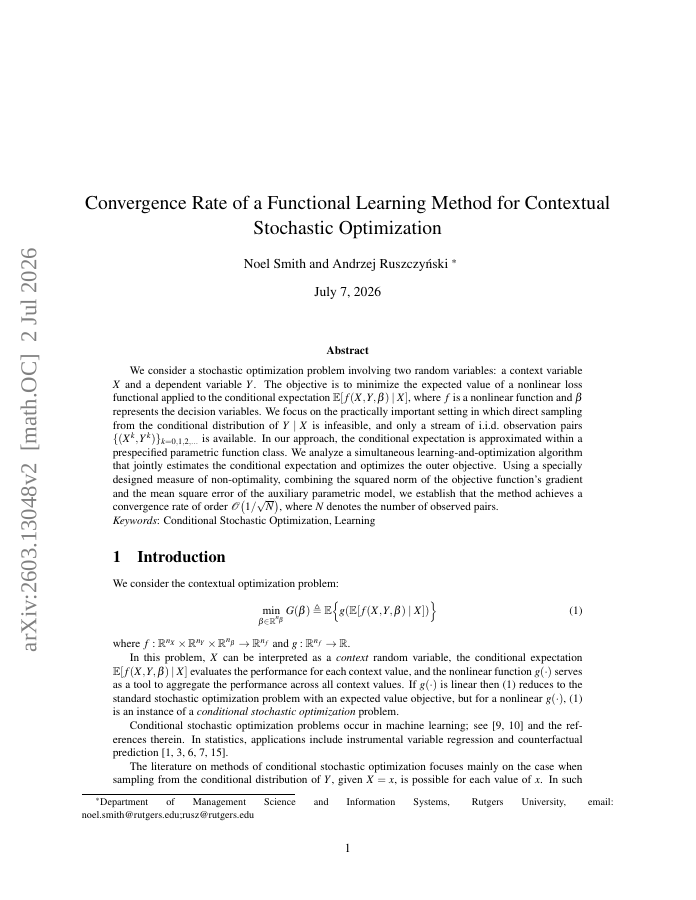
We consider a stochastic optimization problem involving two random variables: a context variable X and a dependent variable Y. The objective is to minimize the expected value of a nonlinear loss functional applied to the conditional expectation \mathbb{E}[f(X, Y,β) \mid X], where f is a nonlinear function and β represents the decision variables. We focus on the practically important setting in which direct sampling from the conditional distribution of Y \mid X is infeasible, and only a stream of i.i.d. observation pairs {(X^k, Y^k)}_{k=0,1,2,\ldots} is available. In our approach, the conditional expectation is approximated within a prespecified parametric function class. We analyze a simultaneous learning-and-optimization algorithm that jointly estimates the conditional expectation and optimizes the outer objective. Using a specially designed measure of non-optimality, combining the squared norm of the objective function's gradient and the mean square error of the auxiliary parametric model, we establish that the method achieves a convergence rate of order O\big(1/\sqrt{N}\big), where N denotes the number of observed pairs.
Convergence Rate of a Functional Learning Method for Contextual Stochastic Optimization
We consider a stochastic optimization problem involving two random variables: a context variable $X$ and a dependent variable $Y$. The objective is to minimize the expected value of a nonlinear loss functional applied to the conditional expectation $\mathbb{E}[f(X, Y,β) \mid…
- Preview
- Year
- 2026
- Hosting
- Abstract onlyARXIV-DEFAULT
Cite
Notes
Only stored in your browser.
Attribution
- Abstract & full text
- arxiv.org/abs/2603.13048ARXIV-DEFAULT
- TL;DR
- Semantic Scholar