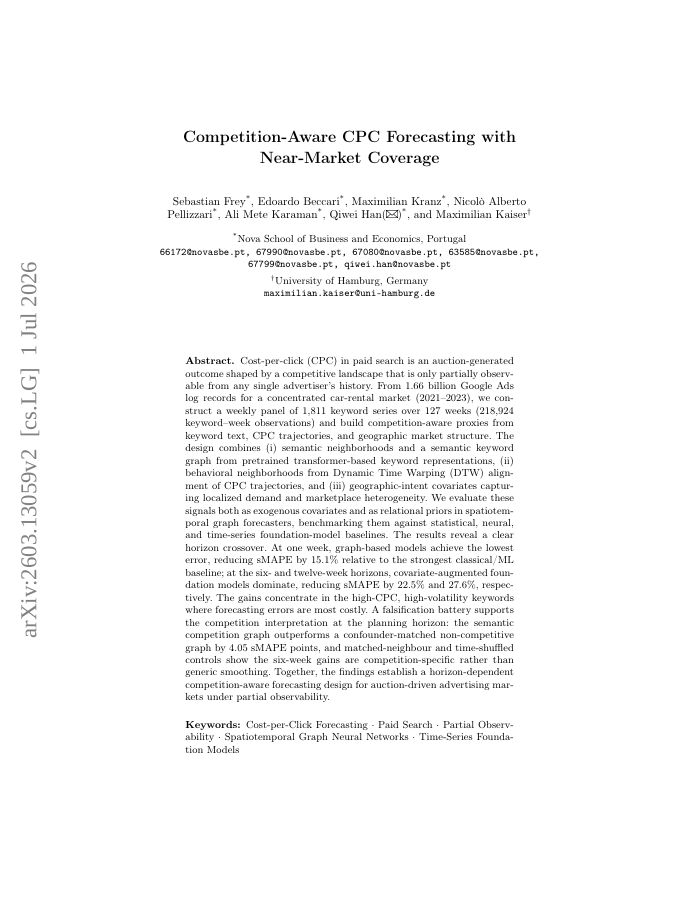
Cost-per-click (CPC) in paid search is an auction-generated outcome shaped by a competitive landscape that is only partially observable from any single advertiser's history. From 1.66 billion Google Ads log records for a concentrated car-rental market (2021-2023), we construct a weekly panel of 1,811 keyword series over 127 weeks (218,924 keyword-week observations) and build competition-aware proxies from keyword text, CPC trajectories, and geographic market structure. The design combines (i) semantic neighborhoods and a semantic keyword graph from pretrained transformer-based keyword representations, (ii) behavioral neighborhoods from Dynamic Time Warping (DTW) alignment of CPC trajectories, and (iii) geographic-intent covariates capturing localized demand and marketplace heterogeneity. We evaluate these signals both as exogenous covariates and as relational priors in spatiotemporal graph forecasters, benchmarking them against statistical, neural, and time-series foundation-model baselines. The results reveal a clear horizon crossover. At one week, graph-based models achieve the lowest error, reducing sMAPE by 15.1% relative to the strongest classical/ML baseline; at the six- and twelve-week horizons, covariate-augmented foundation models dominate, reducing sMAPE by 22.5% and 27.6%, respectively. The gains concentrate in the high-CPC, high-volatility keywords where forecasting errors are most costly. A falsification battery supports the competition interpretation at the planning horizon: the semantic competition graph outperforms a confounder-matched non-competitive graph by 4.05 sMAPE points, and matched-neighbour and time-shuffled controls show the six-week gains are competition-specific rather than generic smoothing. Together, the findings establish a horizon-dependent competition-aware forecasting design for auction-driven advertising markets under partial observability.
Competition-Aware CPC Forecasting with Near-Market Coverage
Cost-per-click (CPC) in paid search is an auction-generated outcome shaped by a competitive landscape that is only partially observable from any single advertiser's history.
- Preview
- Year
- 2026
- Hosting
- Full text hostedCC-BY-4.0
Cite
Notes
Only stored in your browser.
Attribution
- Abstract & full text
- arxiv.org/abs/2603.13059CC-BY-4.0
- TL;DR
- Semantic Scholar