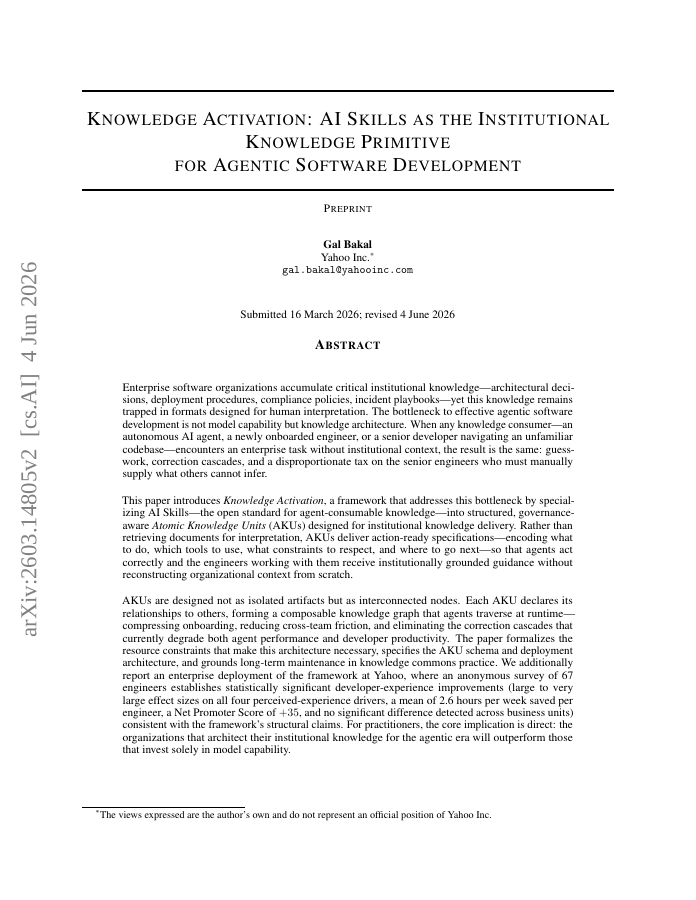
Enterprise software organizations accumulate critical institutional knowledge - architectural decisions, deployment procedures, compliance policies, incident playbooks - yet this knowledge remains trapped in formats designed for human interpretation. The bottleneck to effective agentic software development is not model capability but knowledge architecture. When any knowledge consumer - an autonomous AI agent, a newly onboarded engineer, or a senior developer - encounters an enterprise task without institutional context, the result is guesswork, correction cascades, and a disproportionate tax on senior engineers who must manually supply what others cannot infer. This paper introduces Knowledge Activation, a framework that specializes AI Skills - the open standard for agent-consumable knowledge - into structured, governance-aware Atomic Knowledge Units (AKUs) for institutional knowledge delivery. Rather than retrieving documents for interpretation, AKUs deliver action - ready specifications encoding what to do, which tools to use, what constraints to respect, and where to go next - so that agents act correctly and engineers receive institutionally grounded guidance without reconstructing organizational context from scratch. AKUs form a composable knowledge graph that agents traverse at runtime - compressing onboarding, reducing cross - team friction, and eliminating correction cascades. The paper formalizes the resource constraints that make this architecture necessary, specifies the AKU schema and deployment architecture, and grounds long - term maintenance in knowledge commons practice. A Yahoo deployment surveying 67 engineers shows statistically significant developer-experience gains - 2.6 hours per week saved, Net Promoter Score +35. Organizations that architect their institutional knowledge for the agentic era will outperform those that invest solely in model capability.
Knowledge Activation: AI Skills as the Institutional Knowledge Primitive for Agentic Software Development
Enterprise software organizations accumulate critical institutional knowledge - architectural decisions, deployment procedures, compliance policies, incident playbooks - yet this knowledge remains trapped in formats designed for human interpretation.
- Preview
- Year
- 2026
- Hosting
- Full text hostedCC-BY-4.0
Cite
Notes
Only stored in your browser.
Attribution
- Abstract & full text
- arxiv.org/abs/2603.14805CC-BY-4.0
- TL;DR
- Semantic Scholar