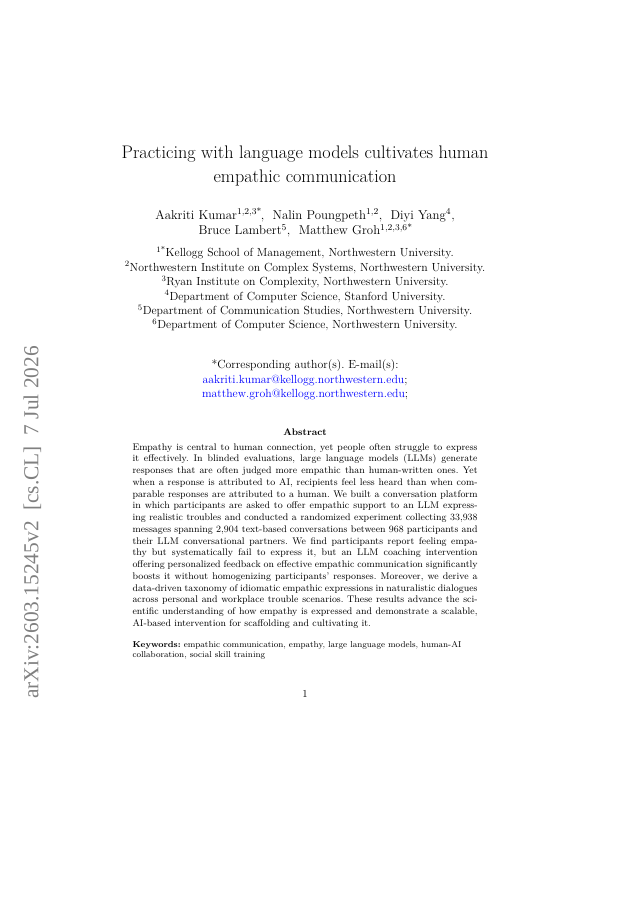
Empathy is central to human connection, yet people often struggle to express it effectively. In blinded evaluations, large language models (LLMs) generate responses that are often judged more empathic than human-written ones. Yet when a response is attributed to AI, recipients feel less heard than when comparable responses are attributed to a human. We built a conversation platform in which participants are asked to offer empathic support to an LLM expressing realistic troubles and conducted a randomized experiment collecting 33,938 messages spanning 2,904 text-based conversations between 968 participants and their LLM conversational partners. We find participants report feeling empathy but systematically fail to express it, but an LLM coaching intervention offering personalized feedback on effective empathic communication significantly boosts it without homogenizing participants' responses. Moreover, we derive a data-driven taxonomy of idiomatic empathic expressions in naturalistic dialogues across personal and workplace trouble scenarios. These results advance the scientific understanding of how empathy is expressed and demonstrate a scalable, AI-based intervention for scaffolding and cultivating it.
Practicing with Language Models Cultivates Human Empathic Communication
Empathy is central to human connection, yet people often struggle to express it effectively. In blinded evaluations, large language models (LLMs) generate responses that are often judged more empathic than human-written ones.
- Preview
- Year
- 2026
- Hosting
- Full text hostedCC-BY-4.0
Cite
Notes
Only stored in your browser.
Attribution
- Abstract & full text
- arxiv.org/abs/2603.15245CC-BY-4.0
- TL;DR
- Semantic Scholar