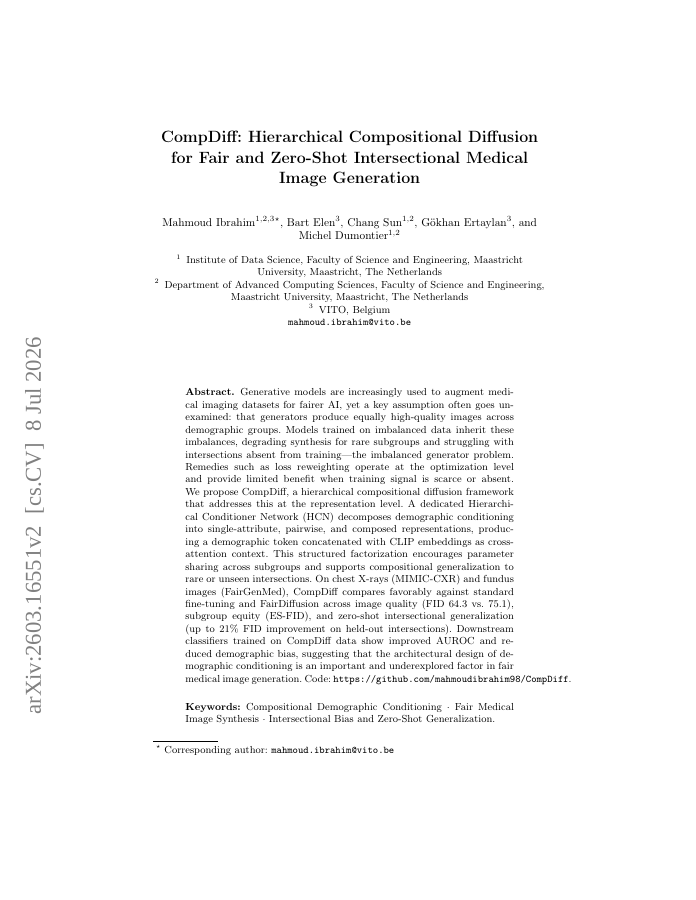
Generative models are increasingly used to augment medical imaging datasets for fairer AI, yet a key assumption often goes unexamined: that generators produce equally high-quality images across demographic groups. Models trained on imbalanced data inherit these imbalances, degrading synthesis for rare subgroups and struggling with intersections absent from training: the imbalanced generator problem. Remedies such as loss reweighting operate at the optimization level and provide limited benefit when training signal is scarce or absent. We propose CompDiff, a hierarchical compositional diffusion framework that addresses this at the representation level. A dedicated Hierarchical Conditioner Network (HCN) decomposes demographic conditioning into single-attribute, pairwise, and composed representations, producing a demographic token concatenated with CLIP embeddings as cross-attention context. This structured factorization encourages parameter sharing across subgroups and supports compositional generalization to rare or unseen intersections. On chest X-rays (MIMIC-CXR) and fundus images (FairGenMed), CompDiff compares favorably against standard fine-tuning and FairDiffusion across image quality (FID 64.3 vs. 75.1), subgroup equity (ES-FID), and zero-shot intersectional generalization (up to 21% FID improvement on held-out intersections). Downstream classifiers trained on CompDiff data show improved AUROC and reduced demographic bias, suggesting that the architectural design of demographic conditioning is an important and underexplored factor in fair medical image generation. Code: https://github.com/mahmoudibrahim98/CompDiff.
CompDiff: Hierarchical Compositional Diffusion for Fair and Zero-Shot Intersectional Medical Image Generation
Generative models are increasingly used to augment medical imaging datasets for fairer AI, yet a key assumption often goes unexamined: that generators produce equally high-quality images across demographic groups.
- Preview
- Year
- 2026
- Hosting
- Full text hostedCC-BY-4.0
Cite
Notes
Only stored in your browser.
Attribution
- Abstract & full text
- arxiv.org/abs/2603.16551CC-BY-4.0
- TL;DR
- Semantic Scholar