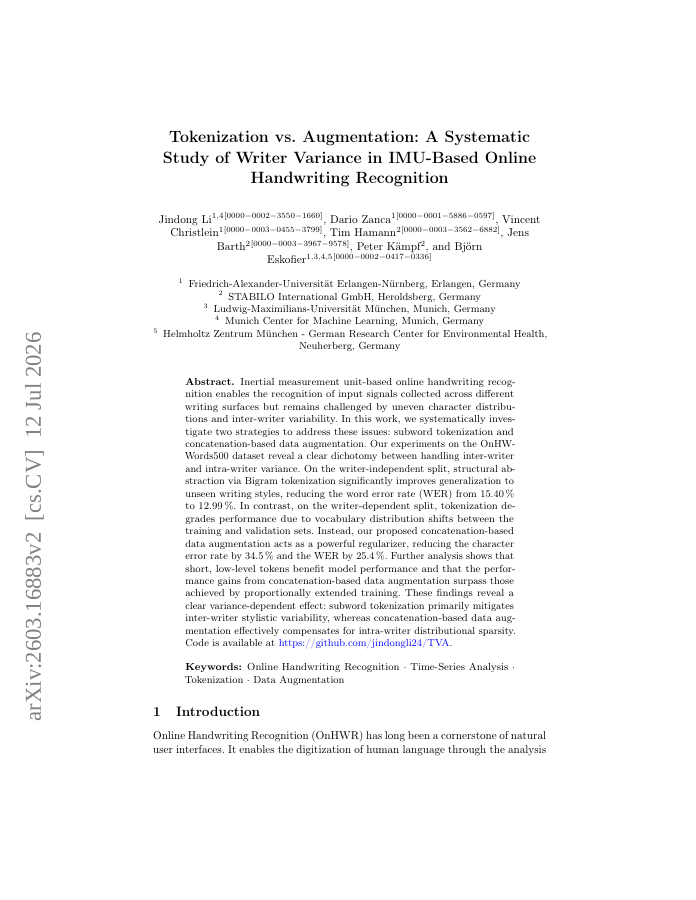
Inertial measurement unit-based online handwriting recognition enables the recognition of input signals collected across different writing surfaces but remains challenged by uneven character distributions and inter-writer variability. In this work, we systematically investigate two strategies to address these issues: subword tokenization and concatenation-based data augmentation. Our experiments on the OnHW-Words500 dataset reveal a clear dichotomy between handling inter-writer and intra-writer variance. On the writer-independent split, structural abstraction via Bigram tokenization significantly improves generalization to unseen writing styles, reducing the word error rate (WER) from 15.40% to 12.99%. In contrast, on the writer-dependent split, tokenization degrades performance due to vocabulary distribution shifts between the training and validation sets. Instead, our proposed concatenation-based data augmentation acts as a powerful regularizer, reducing the character error rate by 34.5% and the WER by 25.4%. Further analysis shows that short, low-level tokens benefit model performance and that the performance gains from concatenation-based data augmentation surpass those achieved by proportionally extended training. These findings reveal a clear variance-dependent effect: subword tokenization primarily mitigates inter-writer stylistic variability, whereas concatenation-based data augmentation effectively compensates for intra-writer distributional sparsity.
Tokenization vs. Augmentation: A Systematic Study of Writer Variance in IMU-Based Online Handwriting Recognition
Inertial measurement unit-based online handwriting recognition enables the recognition of input signals collected across different writing surfaces but remains challenged by uneven character distributions and inter-writer variability.
- Preview
- Year
- 2026
- Hosting
- Abstract onlyARXIV-DEFAULT
Cite
Notes
Only stored in your browser.
Attribution
- Abstract & full text
- arxiv.org/abs/2603.16883ARXIV-DEFAULT
- TL;DR
- Semantic Scholar