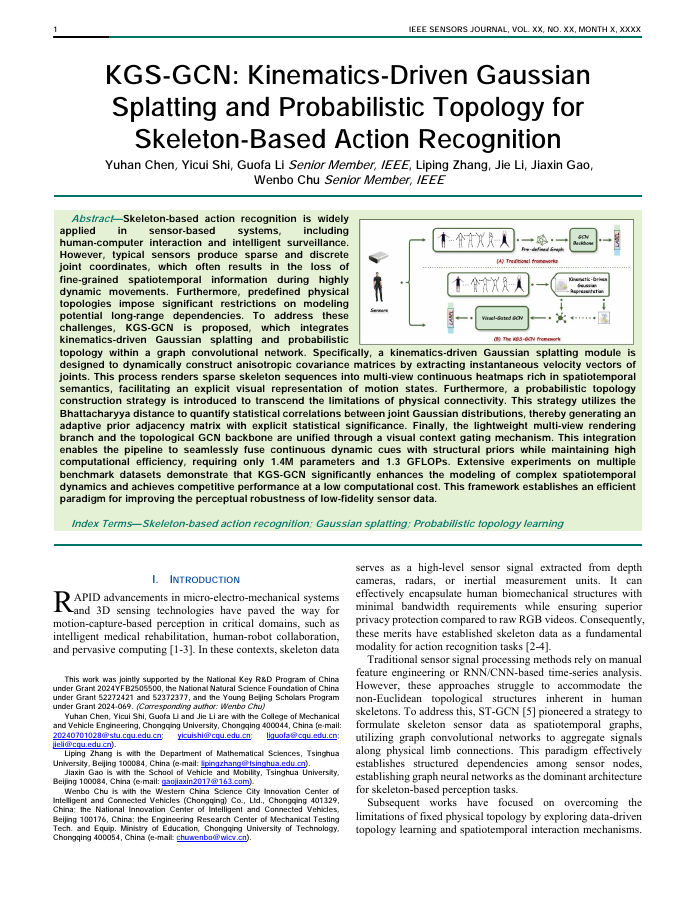
Skeleton-based action recognition is widely applied in sensor-based systems, including human-computer interaction and intelligent surveillance. However, typical sensors produce sparse and discrete joint coordinates, often leading to the loss of fine-grained spatiotemporal information during dynamic movements. Furthermore, predefined physical topologies restrict modeling potential long-range dependencies. To address these challenges, we propose KGS-GCN, which integrates kinematics-driven Gaussian splatting and probabilistic topology within a graph convolutional network. A Gaussian splatting module constructs anisotropic covariance matrices by extracting instantaneous joint velocity vectors, rendering sparse skeleton sequences into multi-view continuous heatmaps rich in spatiotemporal semantics. Additionally, a probabilistic topology construction strategy transcends physical connectivity limitations by utilizing the Bhattacharyya distance to quantify statistical correlations between joint Gaussian distributions, generating an adaptive prior adjacency matrix. Finally, the lightweight multi-view rendering branch and topological GCN backbone are unified through a visual context gating mechanism, enabling seamless fusion of continuous dynamic cues with structural priors while maintaining high computational efficiency, requiring only 1.4M parameters and 1.3 GFLOPs. Extensive experiments on multiple benchmark datasets demonstrate that KGS-GCN significantly enhances the modeling of complex spatiotemporal dynamics and achieves competitive performance at low computational cost, establishing an efficient paradigm for improving the perceptual robustness of low-fidelity sensor data.
KGS-GCN: Kinematics-Driven Gaussian Splatting and Probabilistic Topology for Skeleton-Based Action Recognition
Skeleton-based action recognition is widely applied in sensor-based systems, including human-computer interaction and intelligent surveillance. However, typical sensors produce sparse and discrete joint coordinates, often leading to the loss of fine-grained spatiotemporal…
- Preview
- Year
- 2026
- Hosting
- Abstract onlyARXIV-DEFAULT
Cite
Notes
Only stored in your browser.
Attribution
- Abstract & full text
- arxiv.org/abs/2603.16943ARXIV-DEFAULT
- TL;DR
- Semantic Scholar