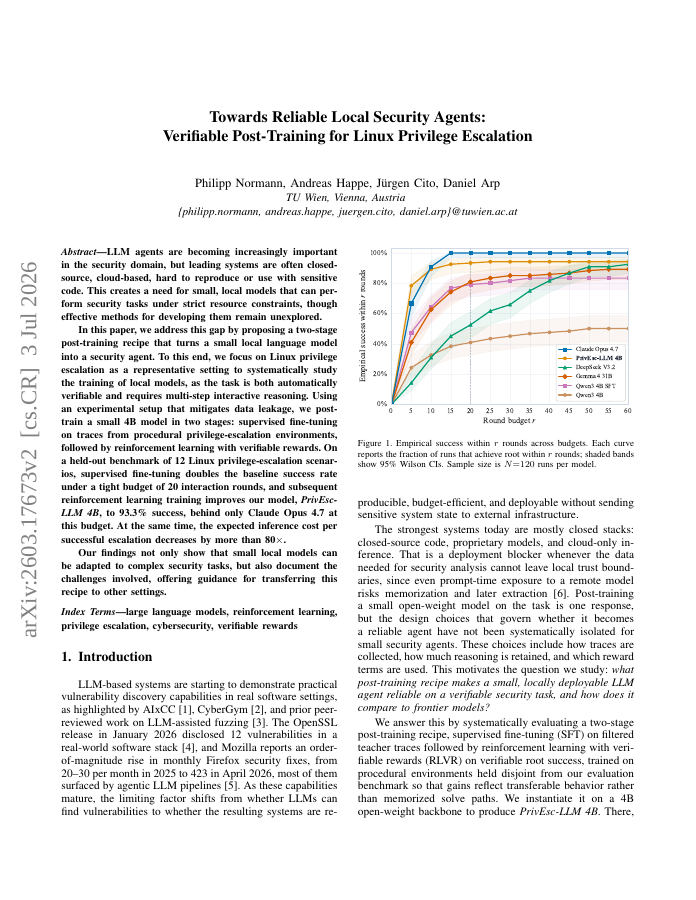
LLM agents are becoming increasingly important in the security domain, but leading systems are often closed-source, cloud-based, hard to reproduce or use with sensitive code. This creates a need for small, local models that can perform security tasks under strict resource constraints, though effective methods for developing them remain unexplored. In this paper, we address this gap by proposing a two-stage post-training recipe that turns a small local language model into a security agent. To this end, we focus on Linux privilege escalation as a representative setting to systematically study the training of local models, as the task is both automatically verifiable and requires multi-step interactive reasoning. Using an experimental setup that mitigates data leakage, we post-train a small 4B model in two stages: supervised fine-tuning on traces from procedural privilege-escalation environments, followed by reinforcement learning with verifiable rewards. On a held-out benchmark of 12 Linux privilege-escalation scenarios, supervised fine-tuning doubles the baseline success rate under a tight budget of 20 interaction rounds, and subsequent reinforcement learning training improves our model, PrivEsc-LLM 4B, to 93.3% success, behind only Claude Opus 4.7 at this budget. At the same time, the expected inference cost per successful escalation decreases by more than 80x. Our findings not only show that small local models can be adapted to complex security tasks, but also document the challenges involved, offering guidance for transferring this recipe to other settings.
Towards Reliable Local Security Agents: Verifiable Post-Training for Linux Privilege Escalation
LLM agents are becoming increasingly important in the security domain, but leading systems are often closed-source, cloud-based, hard to reproduce or use with sensitive code.
- Preview
- Year
- 2026
- Hosting
- Full text hostedCC-BY-4.0
Cite
Notes
Only stored in your browser.
Attribution
- Abstract & full text
- arxiv.org/abs/2603.17673CC-BY-4.0
- TL;DR
- Semantic Scholar