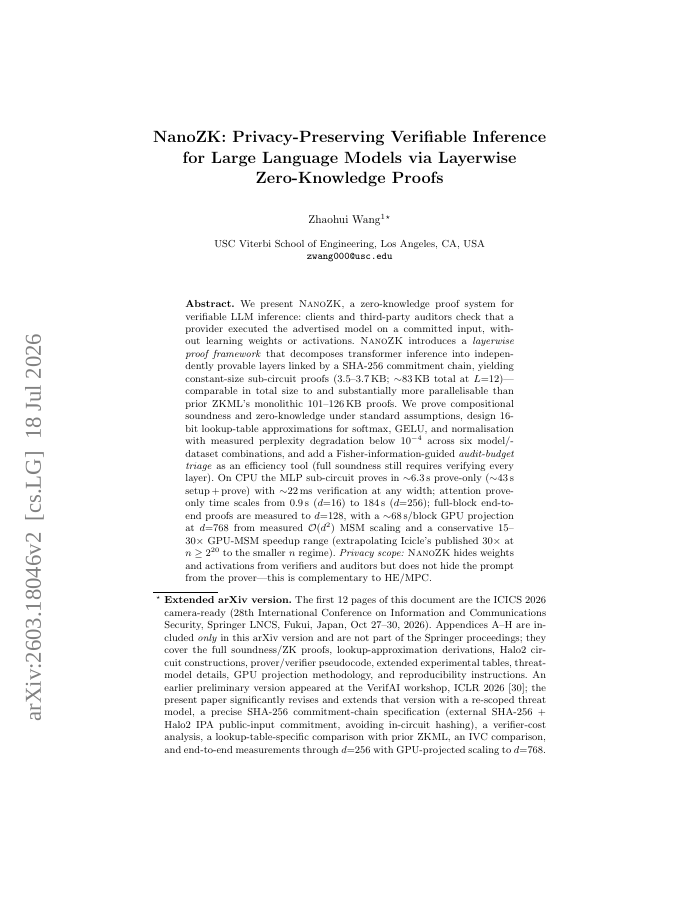
We present NanoZK, a zero-knowledge proof system for verifiable LLM inference: clients and third-party auditors check that a provider executed the advertised model on a committed input without learning weights or activations. NanoZK introduces a layerwise proof framework that decomposes transformer inference into independently provable layers linked by a SHA-256 commitment chain, yielding constant-size sub-circuit proofs (3.5-3.7 KB; about 83 KB total at L=12), comparable in total size to and substantially more parallelizable than prior ZKML's monolithic 101-126 KB proofs. We prove compositional soundness and zero-knowledge under standard assumptions, design 16-bit lookup-table approximations for softmax, GELU, and normalization with measured perplexity degradation below 1e-4 across six model/dataset combinations, and add a Fisher-information-guided audit-budget triage as an efficiency tool (full soundness still requires verifying every layer). On CPU the MLP sub-circuit proves in about 6.3 s prove-only (about 43 s setup plus prove) with about 22 ms verification at any width; attention prove-only time scales from 0.9 s (d=16) to 184 s (d=256); full-block end-to-end proofs are measured to d=128, with a projected GPU time of about 68 s per block at d=768 from measured O(d^2) MSM scaling and a conservative 15-30x GPU-MSM speedup range based on Icicle's published 30x result for n >= 2^20 and extrapolated to the smaller-n regime. Privacy scope: NanoZK hides weights and activations from verifiers and auditors but does not hide the prompt from the prover; this is complementary to HE/MPC.
NanoZK: Privacy-Preserving Verifiable Inference for Large Language Models via Layerwise Zero-Knowledge Proofs
We present NanoZK, a zero-knowledge proof system for verifiable LLM inference: clients and third-party auditors check that a provider executed the advertised model on a committed input without learning weights or activations.
- Preview
- Year
- 2026
- Hosting
- Abstract onlyARXIV-DEFAULT
Cite
Notes
Only stored in your browser.
Attribution
- Abstract & full text
- arxiv.org/abs/2603.18046ARXIV-DEFAULT
- TL;DR
- Semantic Scholar