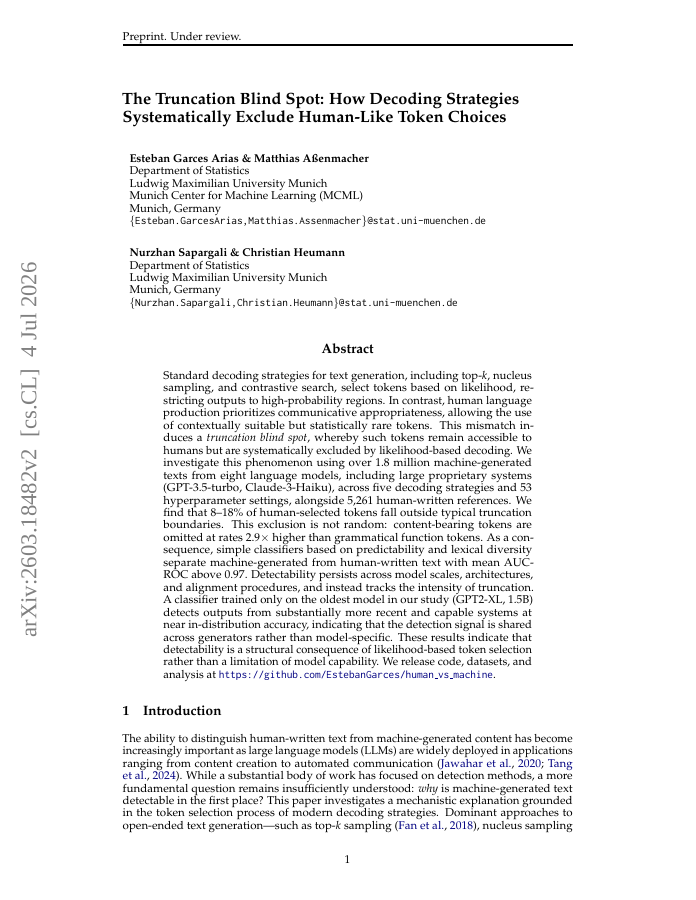
Standard decoding strategies for text generation, including top-k, nucleus sampling, and contrastive search, select tokens based on likelihood, restricting outputs to high-probability regions. In contrast, human language production prioritizes communicative appropriateness, allowing the use of contextually suitable but statistically rare tokens. This mismatch induces a truncation blind spot, whereby such tokens remain accessible to humans but are systematically excluded by likelihood-based decoding. We investigate this phenomenon using over 1.8 million machine-generated texts from eight language models, including large proprietary systems (GPT-3.5-turbo, Claude-3-Haiku), across five decoding strategies and 53 hyperparameter settings, alongside 5,261 human-written references. We find that 8--18% of human-selected tokens fall outside typical truncation boundaries. This exclusion is not random: content-bearing tokens are omitted at rates 2.9\times higher than grammatical function tokens. As a consequence, simple classifiers based on predictability and lexical diversity separate machine-generated from human-written text with mean AUC-ROC above 0.97. Detectability persists across model scales, architectures, and alignment procedures, and instead tracks the intensity of truncation. A classifier trained only on the oldest model in our study (GPT2-XL, 1.5B) detects outputs from substantially more recent and capable systems at near in-distribution accuracy, indicating that the detection signal is shared across generators rather than model-specific. These results indicate that detectability is a structural consequence of likelihood-based token selection rather than a limitation of model capability. We release code, datasets, and analysis at https://github.com/EstebanGarces/human_vs_machine
The Truncation Blind Spot: How Decoding Strategies Systematically Exclude Human-Like Token Choices
Standard decoding strategies for text generation, including top-$k$, nucleus sampling, and contrastive search, select tokens based on likelihood, restricting outputs to high-probability regions.
- Preview
- Year
- 2026
- Hosting
- Full text hostedCC-BY-4.0
Cite
Notes
Only stored in your browser.
Attribution
- Abstract & full text
- arxiv.org/abs/2603.18482CC-BY-4.0
- TL;DR
- Semantic Scholar