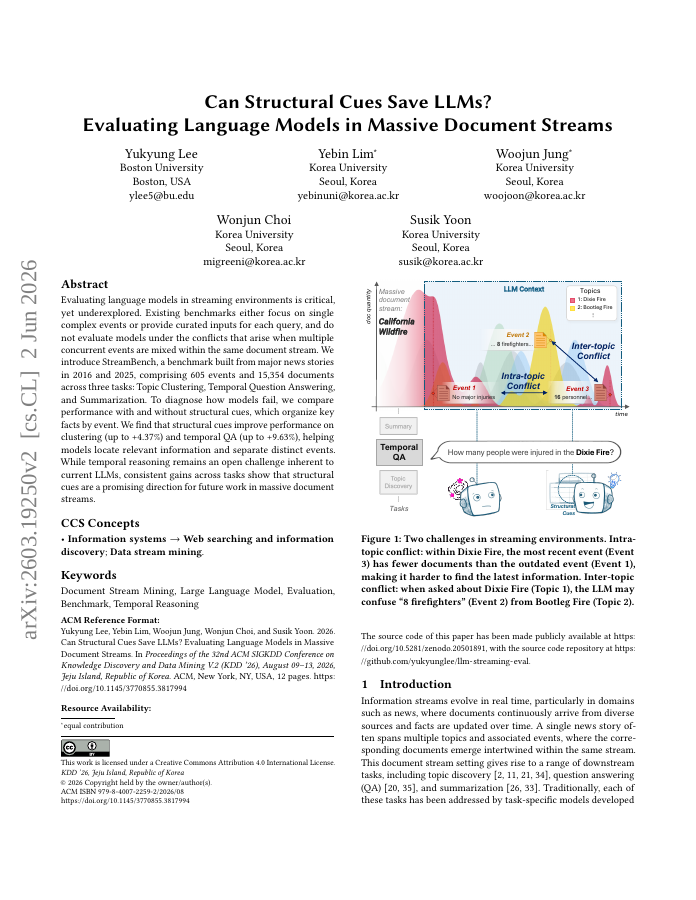
Evaluating language models in streaming environments is critical, yet underexplored. Existing benchmarks either focus on single complex events or provide curated inputs for each query, and do not evaluate models under the conflicts that arise when multiple concurrent events are mixed within the same document stream. We introduce StreamBench, a benchmark built from major news stories in 2016 and 2025, comprising 605 events and 15,354 documents across three tasks: Topic Clustering, Temporal Question Answering, and Summarization. To diagnose how models fail, we compare performance with and without structural cues, which organize key facts by event. We find that structural cues improve performance on clustering (up to +4.37%) and temporal QA (up to +9.63%), helping models locate relevant information and separate distinct events. While temporal reasoning remains an open challenge inherent to current LLMs, consistent gains across tasks show that structural cues are a promising direction for future work in massive document streams.
Can Structural Cues Save LLMs? Evaluating Language Models in Massive Document Streams
Evaluating language models in streaming environments is critical, yet underexplored. Existing benchmarks either focus on single complex events or provide curated inputs for each query, and do not evaluate models under the conflicts that arise when multiple concurrent events are…
- Preview
- Year
- 2026
- Hosting
- Full text hostedCC-BY-SA-4.0
Cite
Notes
Only stored in your browser.
Attribution
- Abstract & full text
- arxiv.org/abs/2603.19250CC-BY-SA-4.0
- TL;DR
- Semantic Scholar