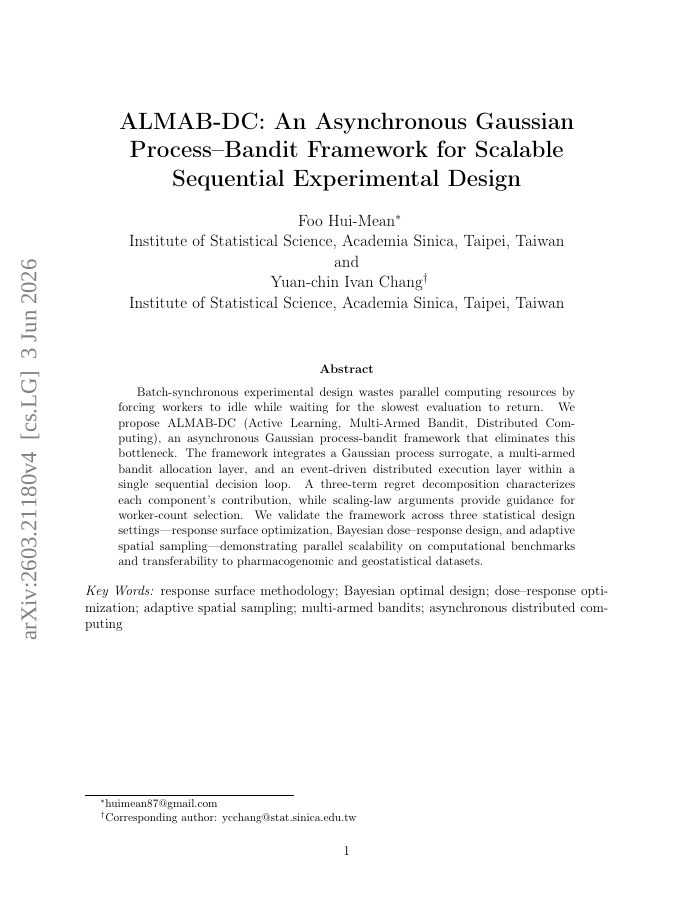
Sequential experimental design under expensive, gradient-free objectives is a central challenge in computational statistics: evaluation budgets are tightly constrained and information must be extracted efficiently from each observation. We propose ALMAB-DC, a GP-based sequential design framework combining active learning, multi-armed bandits (MAB), and distributed asynchronous computing for expensive black-box experimentation. A Gaussian process surrogate with uncertainty-aware acquisition identifies informative query points; a UCB or Thompson-sampling bandit controller allocates evaluations across parallel workers; and an asynchronous scheduler handles heterogeneous runtimes. We present cumulative regret bounds for the bandit components and characterize parallel scalability via Amdahl's Law. We validate ALMAB-DC on five benchmarks. On the two statistical experimental-design tasks, ALMAB-DC achieves lower simple regret than Equal Spacing, Random, and D-optimal designs in dose--response optimization, and in adaptive spatial field estimation matches the Greedy Max-Variance benchmark while outperforming Latin Hypercube Sampling; at K=4 the distributed setting reaches target performance in one-quarter of sequential wall-clock rounds. On three ML/engineering tasks (CIFAR-10 HPO, CFD drag minimization, MuJoCo RL), ALMAB-DC achieves 93.4% CIFAR-10 accuracy (outperforming BOHB by 1.7,pp and Optuna by 1.1,pp), reduces airfoil drag to C_D = 0.059 (36.9% below Grid Search), and improves RL return by 50% over Grid Search. All advantages over non-ALMAB baselines are statistically significant under Bonferroni-corrected Mann--Whitney U tests. Distributed execution achieves 7.5\times speedup at K = 16 agents, consistent with Amdahl's Law.
ALMAB-DC: Active Learning, Multi-Armed Bandits, and Distributed Computing for Sequential Experimental Design and Black-Box Optimization
Sequential experimental design under expensive, gradient-free objectives is a central challenge in computational statistics: evaluation budgets are tightly constrained and information must be extracted efficiently from each observation.
- Preview
- Year
- 2026
- Hosting
- Full text hostedCC-BY-4.0
Cite
Notes
Only stored in your browser.
Attribution
- Abstract & full text
- arxiv.org/abs/2603.21180CC-BY-4.0
- TL;DR
- Semantic Scholar