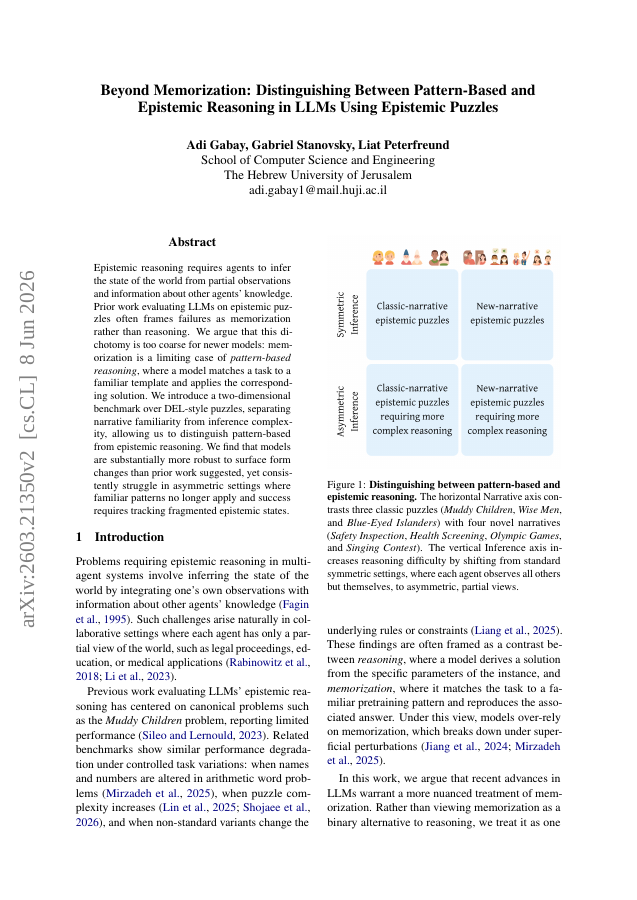
Epistemic reasoning requires agents to infer the state of the world from partial observations and information about other agents' knowledge. Prior work evaluating LLMs on epistemic puzzles often frames failures as memorization rather than reasoning. We argue that this dichotomy is too coarse for newer models: memorization is a limiting case of pattern-based reasoning, where a model matches a task to a familiar template and applies the corresponding solution. We introduce a two-dimensional benchmark over DEL-style puzzles, separating narrative familiarity from inference complexity, allowing us to distinguish pattern-based from epistemic reasoning. We find that models are substantially more robust to surface form changes than prior work suggested, yet consistently struggle in asymmetric settings where familiar patterns no longer apply and success requires tracking fragmented epistemic states.
Beyond Memorization: Distinguishing Between Pattern-Based and Epistemic Reasoning in LLMs Using Epistemic Puzzles
Epistemic reasoning requires agents to infer the state of the world from partial observations and information about other agents' knowledge. Prior work evaluating LLMs on epistemic puzzles often frames failures as memorization rather than reasoning.
- Preview
- Year
- 2026
- Hosting
- Abstract onlyARXIV-DEFAULT
Cite
Notes
Only stored in your browser.
Attribution
- Abstract & full text
- arxiv.org/abs/2603.21350ARXIV-DEFAULT
- TL;DR
- Semantic Scholar