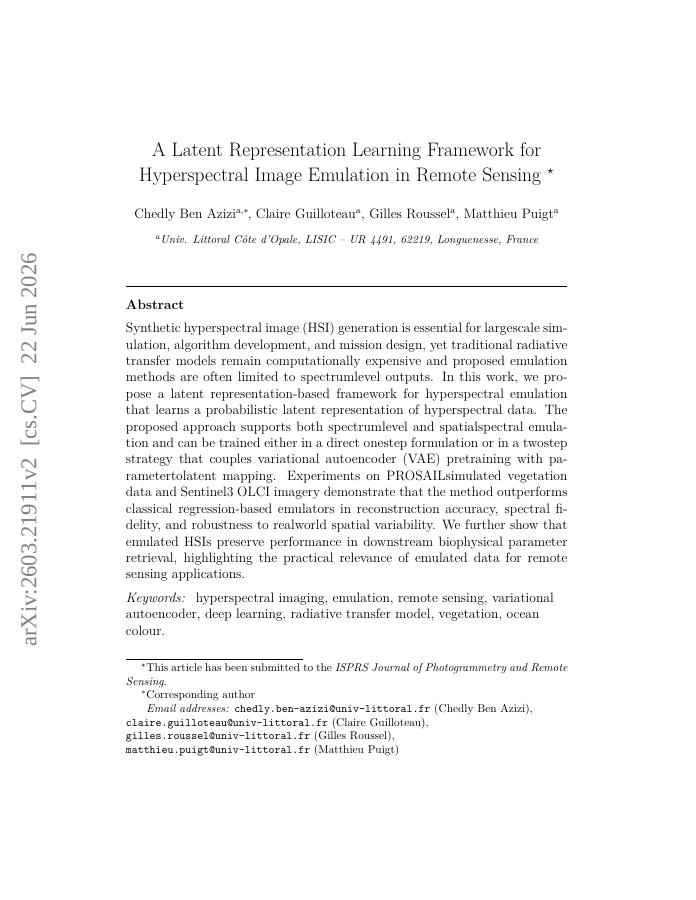
Synthetic hyperspectral image (HSI) generation is essential for large-scale simulation, algorithm development, and mission design, yet traditional radiative transfer models remain computationally expensive and proposed emulation methods are often limited to spectrum-level outputs. In this work, we propose a latent representation-based framework for hyperspectral emulation that learns a probabilistic latent representation of hyperspectral data. The proposed approach supports both spectrum-level and spatial-spectral emulation and can be trained either in a direct one-step formulation or in a two-step strategy that couples variational autoencoder (VAE) pretraining with parameter-to-latent mapping. Experiments on PROSAIL-simulated vegetation data and Sentinel-3 OLCI imagery demonstrate that the method outperforms classical regression-based emulators in reconstruction accuracy, spectral fidelity, and robustness to real-world spatial variability. We further show that emulated HSIs preserve performance in downstream biophysical parameter retrieval, highlighting the practical relevance of emulated data for remote sensing applications.
A Latent Representation Learning Framework for Hyperspectral Image Emulation in Remote Sensing
Synthetic hyperspectral image (HSI) generation is essential for large-scale simulation, algorithm development, and mission design, yet traditional radiative transfer models remain computationally expensive and proposed emulation methods are often limited to spectrum-level…
- Preview
- Year
- 2026
- Hosting
- Full text hostedCC-BY-4.0
Cite
Notes
Only stored in your browser.
Attribution
- Abstract & full text
- arxiv.org/abs/2603.21911CC-BY-4.0
- TL;DR
- Semantic Scholar