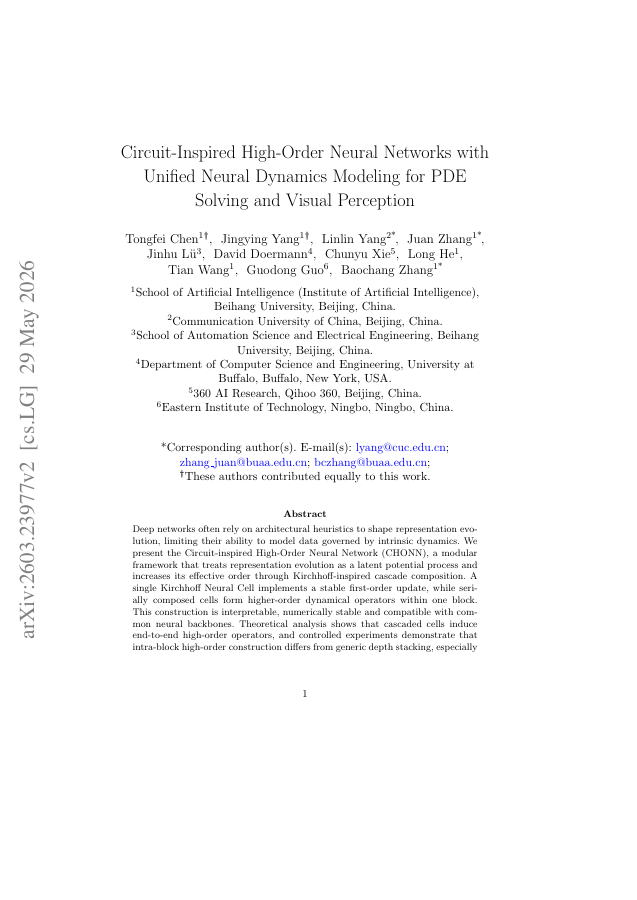
Deep networks often rely on architectural heuristics to shape representation evolution, limiting their ability to model data governed by intrinsic dynamics. We present the Circuit-inspired High-Order Neural Network (CHONN), a modular framework that treats representation evolution as a latent potential process and increases its effective order through Kirchhoff-inspired cascade composition. A single Kirchhoff Neural Cell implements a stable first-order update, while serially composed cells form higher-order dynamical operators within one block. This construction is interpretable, numerically stable and compatible with common neural backbones. Theoretical analysis shows that cascaded cells induce end-to-end high-order operators, and controlled experiments demonstrate that intra-block high-order construction differs from generic depth stacking, especially on derivative-sensitive measures. Across steady-state operator learning, long-horizon physical forecasting and ImageNet-1K recognition, CHONN improves structural fidelity, rollout stability and visual representation learning. These results identify high-order circuit composition as a general principle for neural dynamics modeling.
Circuit-Inspired High-Order Neural Networks with Unified Neural Dynamics Modeling for PDE Solving and Visual Perception
Deep networks often rely on architectural heuristics to shape representation evolution, limiting their ability to model data governed by intrinsic dynamics. We present the Circuit-inspired High-Order Neural Network (CHONN), a modular framework that treats representation…
- Preview
- Year
- 2026
- Hosting
- Full text hostedCC-BY-4.0
Cite
Notes
Only stored in your browser.
Attribution
- Abstract & full text
- arxiv.org/abs/2603.23977CC-BY-4.0
- TL;DR
- Semantic Scholar