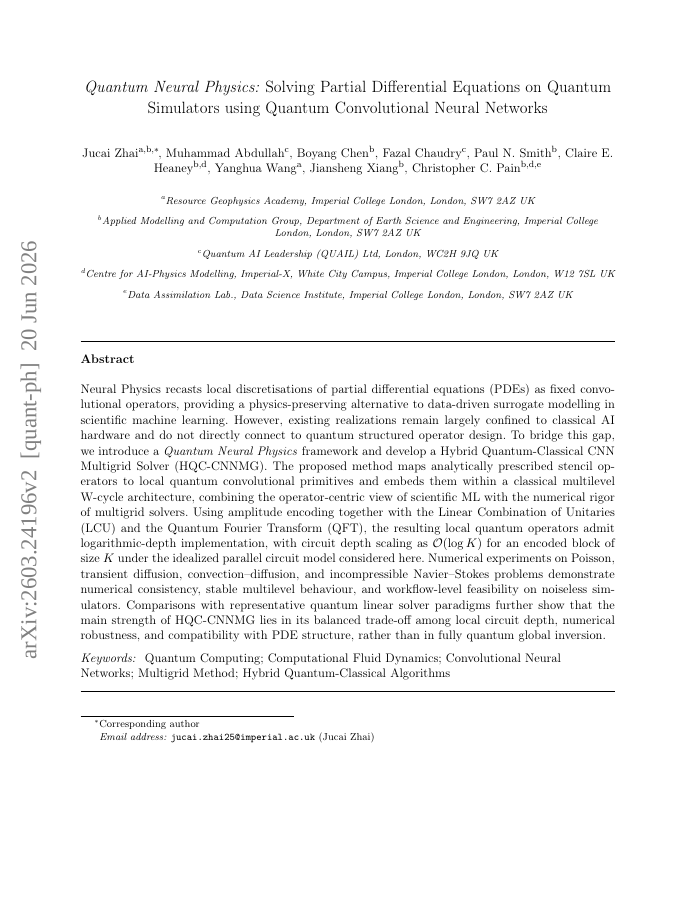
Neural Physics recasts local discretisations of partial differential equations (PDEs) as fixed convolutional operators, providing a physics-preserving alternative to data-driven surrogate modelling in scientific machine learning. However, existing realizations remain largely confined to classical AI hardware and do not directly connect to quantum structured operator design. To bridge this gap, we introduce a Quantum Neural Physics framework and develop a Hybrid Quantum-Classical CNN Multigrid Solver (HQC-CNNMG). The proposed method maps analytically prescribed stencil operators to local quantum convolutional primitives and embeds them within a classical multilevel W-cycle architecture, combining the operator-centric view of scientific ML with the numerical rigor of multigrid solvers. Using amplitude encoding together with the Linear Combination of Unitaries (LCU) and the Quantum Fourier Transform (QFT), the resulting local quantum operators admit logarithmic-depth implementation, with circuit depth scaling as O(\log K) for an encoded block of size K under the idealized parallel circuit model considered here. Numerical experiments on Poisson, transient diffusion, convection--diffusion, and incompressible Navier--Stokes problems demonstrate numerical consistency, stable multilevel behaviour, and workflow-level feasibility on noiseless simulators. Comparisons with representative quantum linear solver paradigms further show that the main strength of HQC-CNNMG lies in its balanced trade-off among local circuit depth, numerical robustness, and compatibility with PDE structure, rather than in fully quantum global inversion.
Quantum Neural Physics: Solving Partial Differential Equations on Quantum Simulators using Quantum Convolutional Neural Networks
Neural Physics recasts local discretisations of partial differential equations (PDEs) as fixed convolutional operators, providing a physics-preserving alternative to data-driven surrogate modelling in scientific machine learning.
- Preview
- Year
- 2026
- Hosting
- Full text hostedCC-BY-4.0
Cite
Notes
Only stored in your browser.
Attribution
- Abstract & full text
- arxiv.org/abs/2603.24196CC-BY-4.0
- TL;DR
- Semantic Scholar