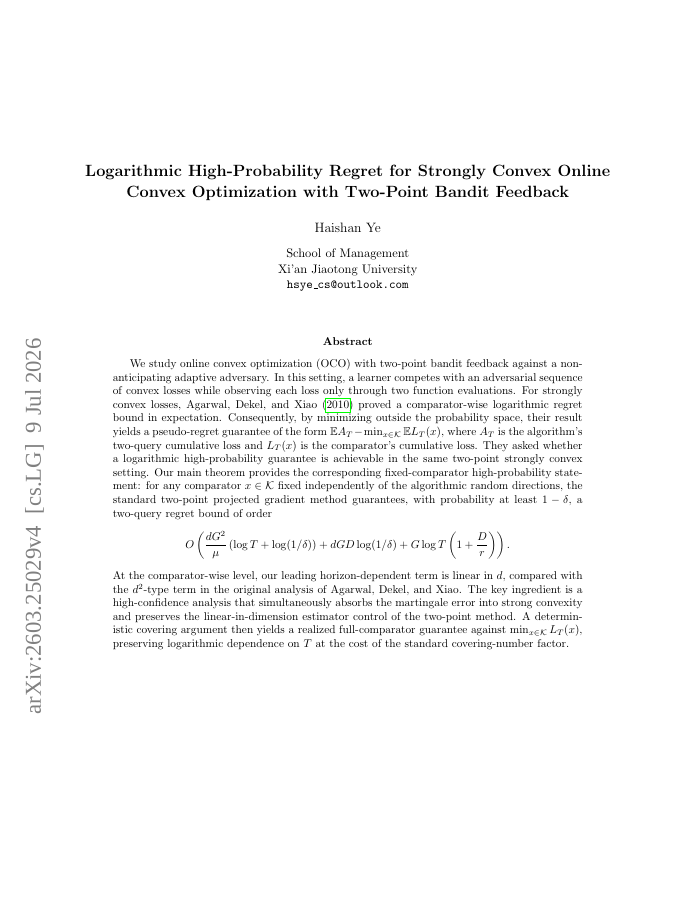
We study online convex optimization (OCO) with two-point bandit feedback against a non-anticipating adaptive adversary. In this setting, a learner competes with an adversarial sequence of convex losses while observing each loss only through two function evaluations. For strongly convex losses, Agarwal, Dekel, and Xiao \citeyearpar{agarwal2010optimal} proved a comparator-wise logarithmic regret bound in expectation. Consequently, by minimizing outside the probability space, their result yields a pseudo-regret guarantee of the form \EB A_T-\min_{x\in\mathcal K}\EB L_T(x), where A_T is the algorithm's two-query cumulative loss and L_T(x) is the comparator's cumulative loss. They asked whether a logarithmic high-probability guarantee is achievable in the same two-point strongly convex setting. Our main theorem provides the corresponding fixed-comparator high-probability statement: for any comparator x\in\mathcal K fixed independently of the algorithmic random directions, the standard two-point projected gradient method guarantees, with probability at least 1-δ, a two-query regret bound of order [ O\left(\frac{dG^2}μ\left(\log T+\log(1/δ)\right)+dGD\log(1/δ)+G\log T\left(1+\frac{D}{r}\right)\right). ] At the comparator-wise level, our leading horizon-dependent term is linear in d, compared with the d^2-type term in the original analysis of Agarwal, Dekel, and Xiao. The key ingredient is a high-confidence analysis that simultaneously absorbs the martingale error into strong convexity and preserves the linear-in-dimension estimator control of the two-point method. A deterministic covering argument then yields a realized full-comparator guarantee against \min_{x\in\mathcal K}L_T(x), preserving logarithmic dependence on T at the cost of the standard covering-number factor.
Logarithmic High-Probability Regret for Online Convex Optimization with Two-Point Bandit Feedback
We study online convex optimization (OCO) with two-point bandit feedback against a non-anticipating adaptive adversary. In this setting, a learner competes with an adversarial sequence of convex losses while observing each loss only through two function evaluations.
- Preview
- Year
- 2026
- Hosting
- Full text hostedCC-BY-4.0
Cite
Notes
Only stored in your browser.
Attribution
- Abstract & full text
- arxiv.org/abs/2603.25029CC-BY-4.0
- TL;DR
- Semantic Scholar