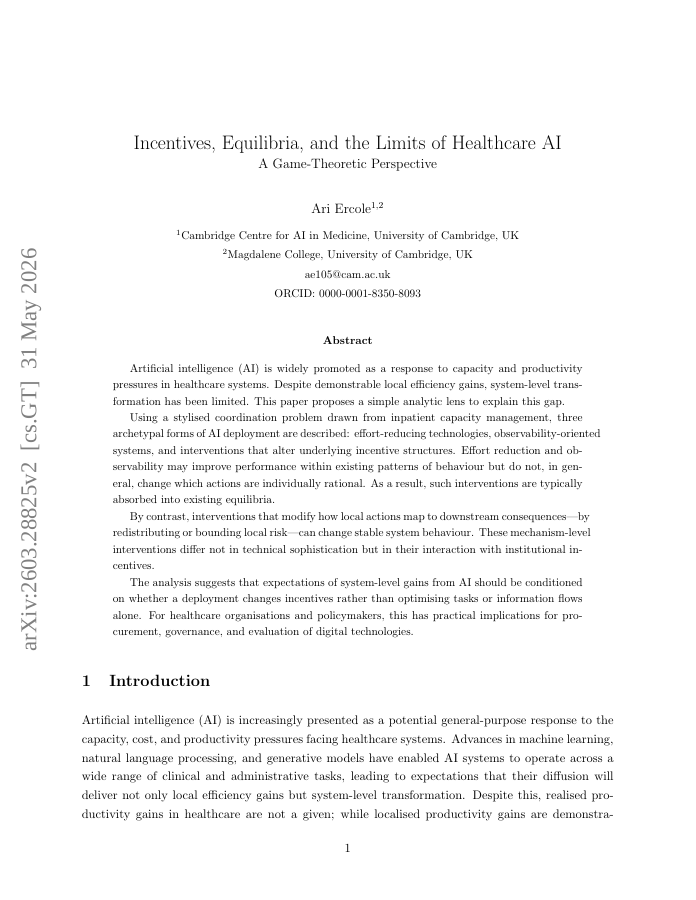
Using a stylised coordination problem drawn from inpatient capacity management, three archetypal forms of AI deployment are described: effort-reducing technologies, observability-oriented systems, and interventions that alter underlying incentive structures. Effort reduction and observability may improve performance within existing patterns of behaviour but do not, in general, change which actions are individually rational. As a result, such interventions are typically absorbed into existing equilibria. By contrast, interventions that modify how local actions map to downstream consequences by redistributing or bounding local risk can change stable system behaviour. These mechanism-level interventions differ not in technical sophistication but in their interaction with institutional incentives. The analysis suggests that expectations of system-level gains from AI should be conditioned on whether a deployment changes incentives rather than optimising tasks or information flows alone. For healthcare organisations and policymakers, this has practical implications for procurement, governance, and evaluation of digital technologies.
Incentives, Equilibria, and the Limits of Healthcare AI: A Game-Theoretic Perspective
Using a stylised coordination problem drawn from inpatient capacity management, three archetypal forms of AI deployment are described: effort-reducing technologies, observability-oriented systems, and interventions that alter underlying incentive structures.
- Preview
- Year
- 2026
- Hosting
- Full text hostedCC-BY-4.0
Cite
Notes
Only stored in your browser.
Attribution
- Abstract & full text
- arxiv.org/abs/2603.28825CC-BY-4.0
- TL;DR
- Semantic Scholar