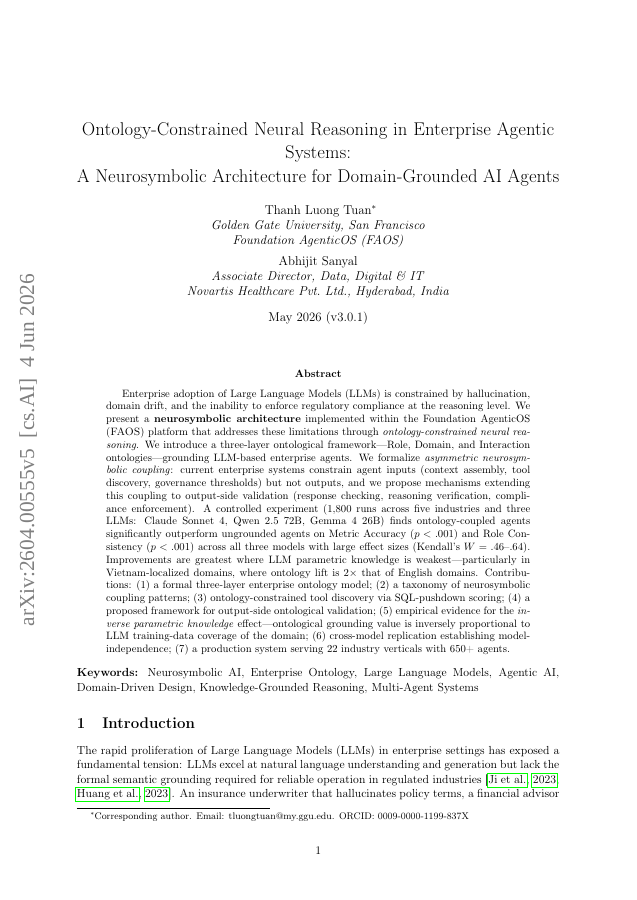
Enterprise adoption of Large Language Models (LLMs) is constrained by hallucination, domain drift, and the inability to enforce regulatory compliance at the reasoning level. We present a neurosymbolic architecture implemented within the Foundation AgenticOS (FAOS) platform that addresses these limitations through ontology-constrained neural reasoning. We introduce a three-layer ontological framework--Role, Domain, and Interaction ontologies--grounding LLM-based enterprise agents. We formalize asymmetric neurosymbolic coupling: current enterprise systems constrain agent inputs (context assembly, tool discovery, governance thresholds) but not outputs, and we propose mechanisms extending this coupling to output-side validation (response checking, reasoning verification, compliance enforcement). A controlled experiment (1,800 runs across five industries and three LLMs: Claude Sonnet 4, Qwen 2.5 72B, Gemma 4 26B) finds ontology-coupled agents significantly outperform ungrounded agents on Metric Accuracy (p < .001) and Role Consistency (p < .001) across all three models with large effect sizes (Kendall's W = .46-.64). Improvements are greatest where LLM parametric knowledge is weakest--particularly in Vietnam-localized domains, where ontology lift is 2x that of English domains. Contributions: (1) a formal three-layer enterprise ontology model; (2) a taxonomy of neurosymbolic coupling patterns; (3) ontology-constrained tool discovery via SQL-pushdown scoring; (4) a proposed framework for output-side ontological validation; (5) empirical evidence for the inverse parametric knowledge effect--ontological grounding value is inversely proportional to LLM training-data coverage of the domain; (6) cross-model replication establishing model-independence; (7) a production system serving 22 industry verticals with 650+ agents.
Ontology-Constrained Neural Reasoning in Enterprise Agentic Systems: A Neurosymbolic Architecture for Domain-Grounded AI Agents
Enterprise adoption of Large Language Models (LLMs) is constrained by hallucination, domain drift, and the inability to enforce regulatory compliance at the reasoning level.
- Preview
- Year
- 2026
- Hosting
- Full text hostedCC-BY-4.0
Cite
Notes
Only stored in your browser.
Attribution
- Abstract & full text
- arxiv.org/abs/2604.00555CC-BY-4.0
- TL;DR
- Semantic Scholar