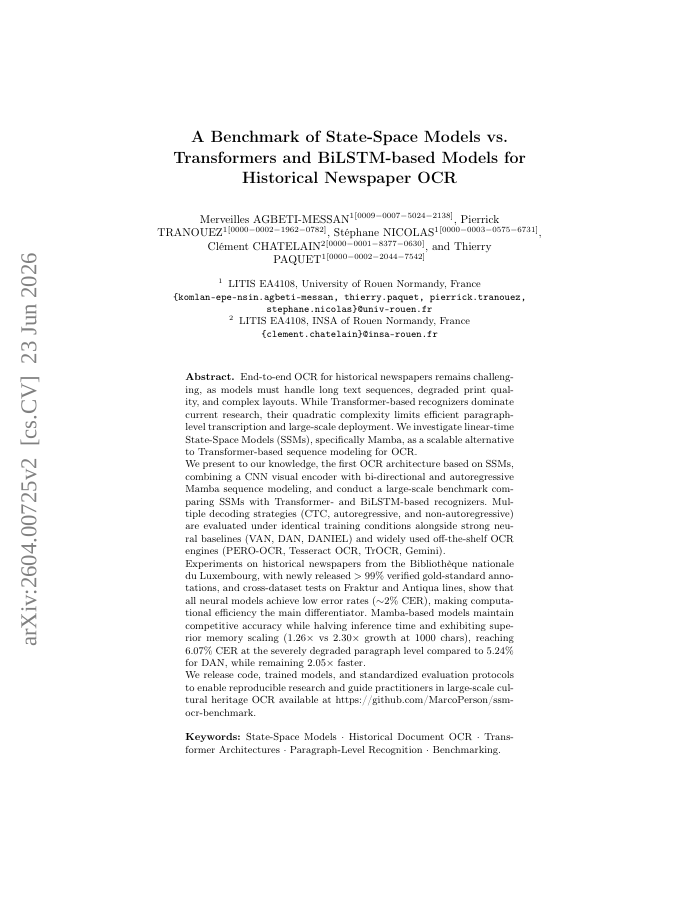
End-to-end OCR for historical newspapers remains challenging, as models must handle long text sequences, degraded print quality, and complex layouts. While Transformer-based recognizers dominate current research, their quadratic complexity limits efficient paragraph-level transcription and large-scale deployment. We investigate linear-time State-Space Models (SSMs), specifically Mamba, as a scalable alternative to Transformer-based sequence modeling for OCR. We present to our knowledge, the first OCR architecture based on SSMs, combining a CNN visual encoder with bi-directional and autoregressive Mamba sequence modeling, and conduct a large-scale benchmark comparing SSMs with Transformer- and BiLSTM-based recognizers. Multiple decoding strategies (CTC, autoregressive, and non-autoregressive) are evaluated under identical training conditions alongside strong neural baselines (VAN, DAN, DANIEL) and widely used off-the-shelf OCR engines (PERO-OCR, Tesseract OCR, TrOCR, Gemini). Experiments on historical newspapers from the Bibliotheque nationale du Luxembourg, with newly released >99% verified gold-standard annotations, and cross-dataset tests on Fraktur and Antiqua lines, show that all neural models achieve low error rates ( 2% CER), making computational efficiency the main differentiator. Mamba-based models maintain competitive accuracy while halving inference time and exhibiting superior memory scaling (1.26x vs 2.30x growth at 1000 chars), reaching 6.07% CER at the severely degraded paragraph level compared to 5.24% for DAN, while remaining 2.05x faster. We release code, trained models, and standardized evaluation protocols to enable reproducible research and guide practitioners in large-scale cultural heritage OCR available at https://github.com/MarcoPerson/ssm-ocr-benchmark.
A Benchmark of State-Space Models vs. Transformers and BiLSTM-based Models for Historical Newspaper OCR
End-to-end OCR for historical newspapers remains challenging, as models must handle long text sequences, degraded print quality, and complex layouts. While Transformer-based recognizers dominate current research, their quadratic complexity limits efficient paragraph-level…
- Preview
- Year
- 2026
- Hosting
- Full text hostedCC-BY-4.0
Cite
Notes
Only stored in your browser.
Attribution
- Abstract & full text
- arxiv.org/abs/2604.00725CC-BY-4.0
- TL;DR
- Semantic Scholar