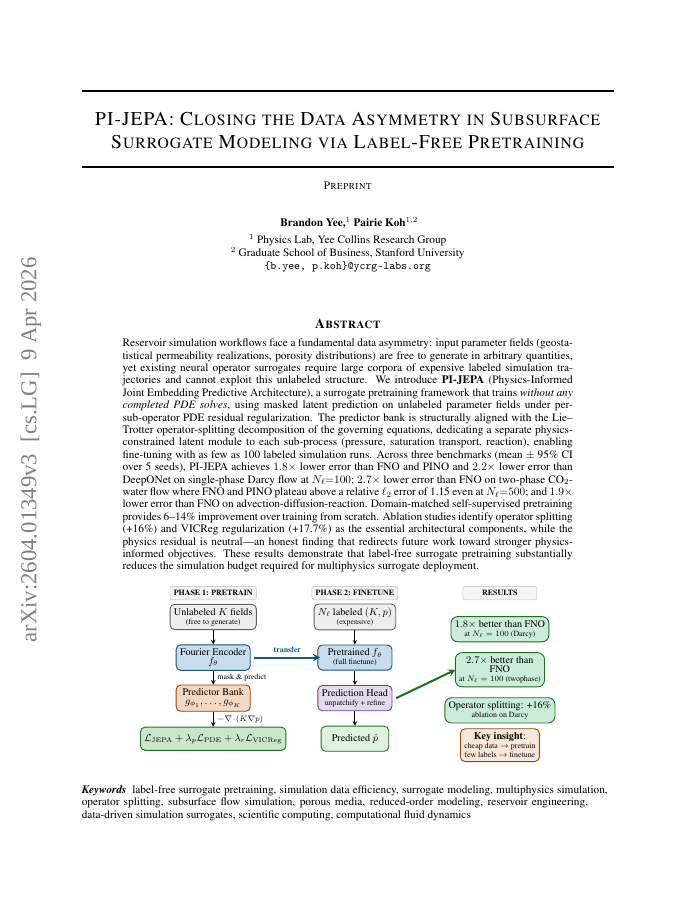
Reservoir simulation workflows face a fundamental data asymmetry: input parameter fields (geostatistical permeability realizations, porosity distributions) are free to generate in arbitrary quantities, yet existing neural operator surrogates require large corpora of expensive labeled simulation trajectories and cannot exploit this unlabeled structure. We introduce PI-JEPA (Physics-Informed Joint Embedding Predictive Architecture), a surrogate pretraining framework that trains without any completed PDE solves, using masked latent prediction on unlabeled parameter fields under per-sub-operator PDE residual regularization. The predictor bank is structurally aligned with the Lie--Trotter operator-splitting decomposition of the governing equations, dedicating a separate physics-constrained latent module to each sub-process (pressure, saturation transport, reaction), enabling fine-tuning with as few as 100 labeled simulation runs. On single-phase Darcy flow, PI-JEPA achieves 1.9\times lower error than FNO and 2.4\times lower error than DeepONet at N_\ell{=}100, with 24% improvement over supervised-only training at N_\ell{=}500, demonstrating that label-free surrogate pretraining substantially reduces the simulation budget required for multiphysics surrogate deployment.
PI-JEPA: Label-Free Surrogate Pretraining for Coupled Multiphysics Simulation via Operator-Split Latent Prediction
Reservoir simulation workflows face a fundamental data asymmetry: input parameter fields (geostatistical permeability realizations, porosity distributions) are free to generate in arbitrary quantities, yet existing neural operator surrogates require large corpora of expensive…
- Preview
- Year
- 2026
- Hosting
- Full text hostedCC-BY-4.0
Cite
Notes
Only stored in your browser.
Attribution
- Abstract & full text
- arxiv.org/abs/2604.01349CC-BY-4.0
- TL;DR
- Semantic Scholar