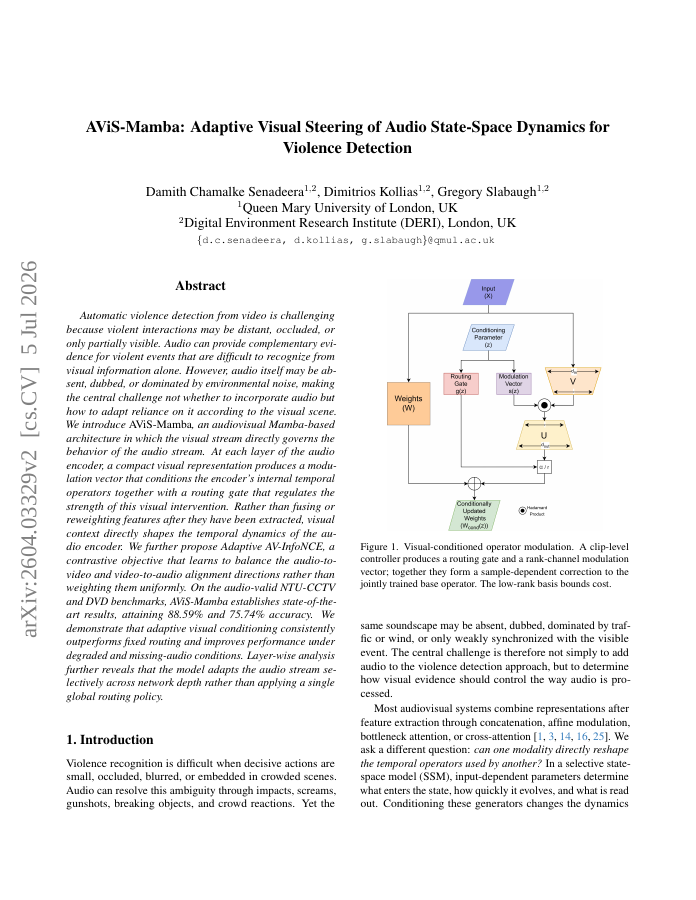
Automatic violence detection from video is challenging because violent interactions may be distant, occluded, or only partially visible. Audio can provide complementary evidence for violent events that are difficult to recognize from visual information alone. However, audio itself may be absent, dubbed, or dominated by environmental noise, making the central challenge not whether to incorporate audio but how to adapt reliance on it according to the visual scene. We introduce AViS-Mamba, an audiovisual Mamba-based architecture in which the visual stream directly governs the behavior of the audio stream. At each layer of the audio encoder, a compact visual representation produces a modulation vector that conditions the encoder's internal temporal operators together with a routing gate that regulates the strength of this visual intervention. Rather than fusing or reweighting features after they have been extracted, visual context directly shapes the temporal dynamics of the audio encoder. We further propose Adaptive AV-InfoNCE, a contrastive objective that learns to balance the audio-to-video and video-to-audio alignment directions rather than weighting them uniformly. On the audio-valid NTU-CCTV and DVD benchmarks, AViS-Mamba establishes state-of-the-art results, attaining 88.59% and 75.74% accuracy. We demonstrate that adaptive visual conditioning consistently outperforms fixed routing and improves performance under degraded and missing-audio conditions. Layer-wise analysis further reveals that the model adapts the audio stream selectively across network depth rather than applying a single global routing policy.
AViS-Mamba: Adaptive Visual Steering of Audio State-Space Dynamics for Violence Detection
Automatic violence detection from video is challenging because violent interactions may be distant, occluded, or only partially visible. Audio can provide complementary evidence for violent events that are difficult to recognize from visual information alone.
- Preview
- Year
- 2026
- Hosting
- Full text hostedCC-BY-4.0
Cite
Notes
Only stored in your browser.
Attribution
- Abstract & full text
- arxiv.org/abs/2604.03329CC-BY-4.0
- TL;DR
- Semantic Scholar