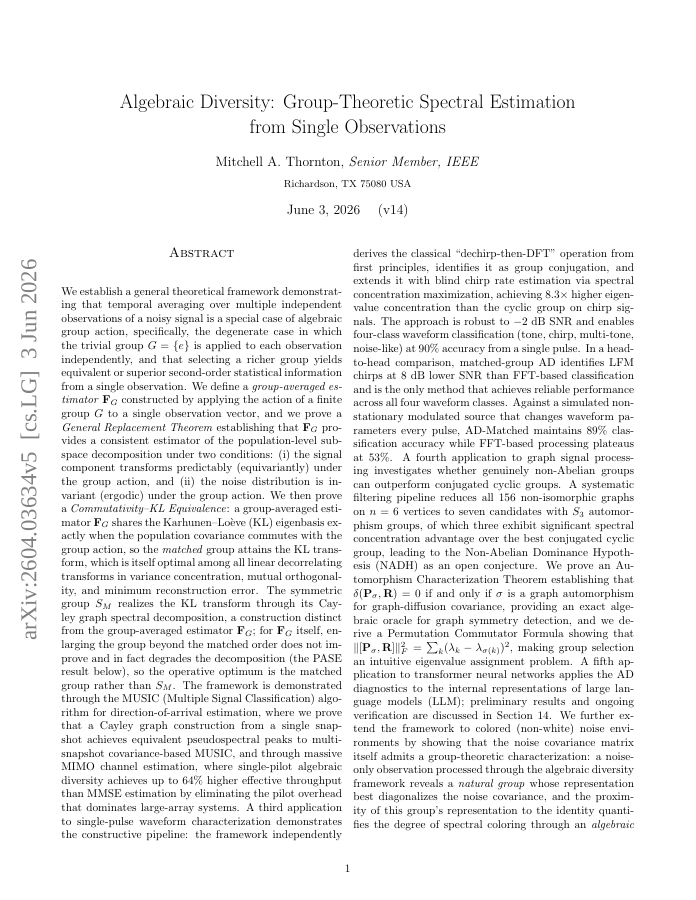
We establish that temporal averaging over multiple observations is the degenerate case of algebraic group action with the trivial group G={e}. A General Replacement Theorem proves that a group-averaged estimator from one snapshot achieves equivalent subspace decomposition to multi-snapshot covariance estimation. The Trivial Group Embedding Theorem proves that the sample covariance is the accumulation of trivial-group estimates, with variance governed by a (G,L) continuum as 1/(|G|\cdot L). The processing gain 10\log_{10}(M) dB equals the classical beamforming gain, establishing that this gain is a property of group order, not sensor count. The DFT, DCT, and KLT are unified as group-matched special cases. We conjecture a General Algebraic Averaging Theorem extending these results to arbitrary statistics, with variance governed by the effective group order d_{eff}. Monte Carlo experiments on the first four sample moments across five group types confirm the conjecture to four-digit precision. The framework exploits the structure of information (representation-theoretic symmetry of the data object) rather than the content, complementing Shannon's theory. Five applications are demonstrated: single-snapshot MUSIC, massive MIMO, single-pulse waveform classification, graph signal processing, and analysis of transformer LLMs. Techniques for blind group matching are described.
Algebraic Diversity: Group-Theoretic Spectral Estimation from Single Observations
We establish that temporal averaging over multiple observations is the degenerate case of algebraic group action with the trivial group $G=\{e\}$. A General Replacement Theorem proves that a group-averaged estimator from one snapshot achieves equivalent subspace decomposition to…
- Preview
- Year
- 2026
- Hosting
- Abstract onlyARXIV-DEFAULT
Cite
Notes
Only stored in your browser.
Attribution
- Abstract & full text
- arxiv.org/abs/2604.03634ARXIV-DEFAULT
- TL;DR
- Semantic Scholar