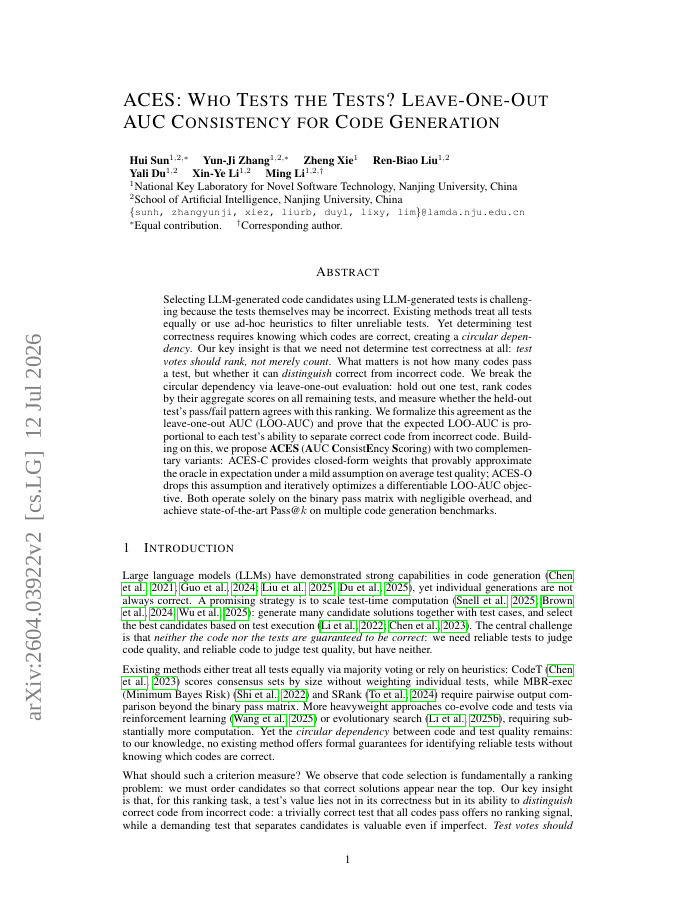
Selecting LLM-generated code candidates using LLM-generated tests is challenging because the tests themselves may be incorrect. Existing methods either treat all tests equally or rely on ad-hoc heuristics to filter unreliable tests. Yet determining test correctness requires knowing which codes are correct, creating a circular dependency. Our key insight is that we need not determine test correctness at all: test votes should rank, not merely count. What matters is not how many codes pass a test, but whether the test can distinguish correct from incorrect code. We break the circular dependency via leave-one-out evaluation: hold out one test, rank codes by their aggregate scores on all remaining tests, and measure whether the held-out test's pass/fail pattern agrees with this ranking. We formalize this agreement as the leave-one-out AUC (LOO-AUC) and prove that the expected LOO-AUC is proportional to each test's ability to separate correct code from incorrect code. Building on this, we propose ACES (AUC ConsistEncy Scoring) with two complementary variants: ACES-C provides closed-form weights that provably approximate the oracle in expectation under a mild assumption on average test quality; ACES-O drops this assumption and iteratively optimizes a differentiable LOO-AUC objective. Both operate solely on the binary pass matrix with negligible overhead, and achieve state-of-the-art Pass@k on multiple code generation benchmarks.
ACES: Who Tests the Tests? Leave-One-Out AUC Consistency for Code Generation
Selecting LLM-generated code candidates using LLM-generated tests is challenging because the tests themselves may be incorrect. Existing methods either treat all tests equally or rely on ad-hoc heuristics to filter unreliable tests.
- Preview
- Year
- 2026
- Hosting
- Abstract onlyARXIV-DEFAULT
Cite
Notes
Only stored in your browser.
Attribution
- Abstract & full text
- arxiv.org/abs/2604.03922ARXIV-DEFAULT
- TL;DR
- Semantic Scholar