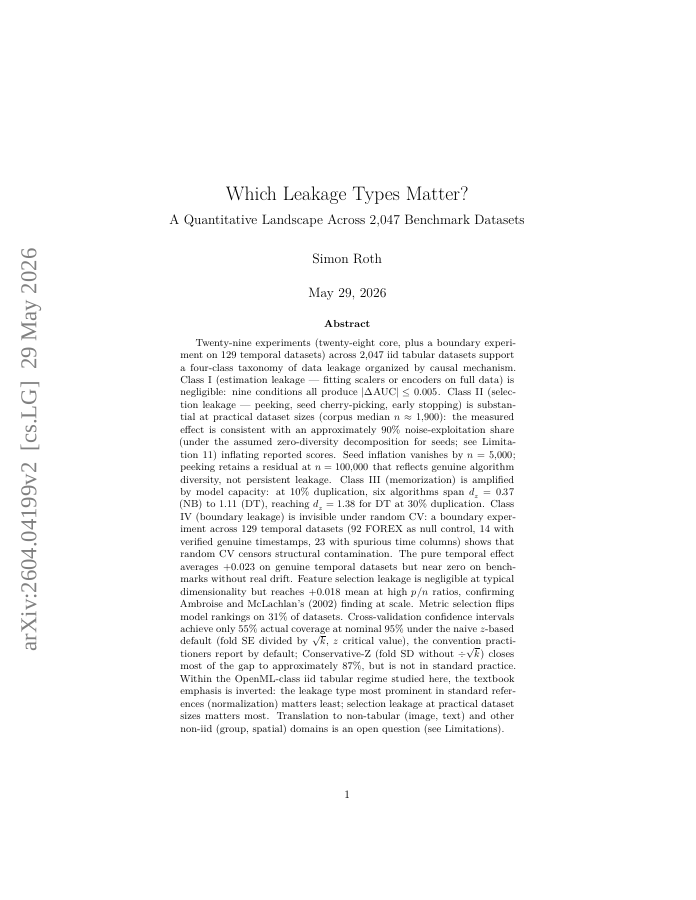
Twenty-eight within-subject counterfactual experiments across 2,047 iid tabular datasets, plus a boundary experiment on 129 temporal datasets, measure the severity of four data leakage classes in machine learning. Class I (estimation: fitting scalers on full data) is negligible: all nine conditions produce |ΔAUC| \leq 0.005. Class II (selection: peeking, seed cherry-picking) is substantial: the measured effect is consistent with about 90% noise exploitation inflating reported scores. Class III (memorization) scales with model capacity: d_z = 0.37 (Naive Bayes) to 1.11 (Decision Tree) at 10% duplication. Class IV (boundary) is invisible under random cross-validation. Within this iid tabular regime, the textbook emphasis is inverted: normalization leakage matters least; selection leakage at practical dataset sizes matters most.
Which Leakage Types Matter? A Quantitative Landscape Across 2,047 Benchmark Datasets
Twenty-eight within-subject counterfactual experiments across 2,047 iid tabular datasets, plus a boundary experiment on 129 temporal datasets, measure the severity of four data leakage classes in machine learning.
- Preview
- Year
- 2026
- Hosting
- Full text hostedCC-BY-4.0
Cite
Notes
Only stored in your browser.
Attribution
- Abstract & full text
- arxiv.org/abs/2604.04199CC-BY-4.0
- TL;DR
- Semantic Scholar