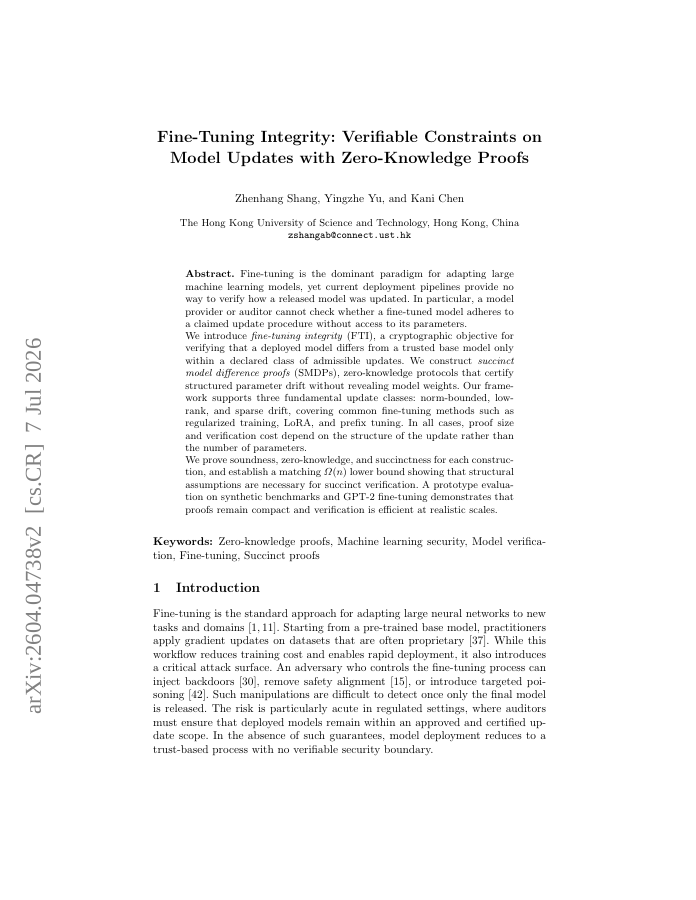
Fine-tuning is the dominant paradigm for adapting large machine learning models, yet current deployment pipelines provide no way to verify how a released model was updated. In particular, a model provider or auditor cannot check whether a fine-tuned model adheres to a claimed update procedure without access to its parameters. We introduce fine-tuning integrity (FTI), a cryptographic objective for verifying that a deployed model differs from a trusted base model only within a declared class of admissible updates. We construct succinct model difference proofs (SMDPs), zero-knowledge protocols that certify structured parameter drift without revealing model weights. Our framework supports three fundamental update classes: norm-bounded, low-rank, and sparse drift, covering common fine-tuning methods such as regularized training, LoRA, and prefix tuning. In all cases, proof size and verification cost depend on the structure of the update rather than the number of parameters. We prove soundness, zero-knowledge, and succinctness for each construction, and establish a matching Ω(n) lower bound showing that structural assumptions are necessary for succinct verification. A prototype evaluation on synthetic benchmarks and GPT-2 fine-tuning demonstrates that proofs remain compact and verification is efficient at realistic scales.
Fine-Tuning Integrity for Modern Neural Networks: Structured Drift Proofs via Norm, Rank, and Sparsity Certificates
Fine-tuning is the dominant paradigm for adapting large machine learning models, yet current deployment pipelines provide no way to verify how a released model was updated.
- Preview
- Year
- 2026
- Hosting
- Full text hostedCC-BY-4.0
Cite
Notes
Only stored in your browser.
Attribution
- Abstract & full text
- arxiv.org/abs/2604.04738CC-BY-4.0
- TL;DR
- Semantic Scholar