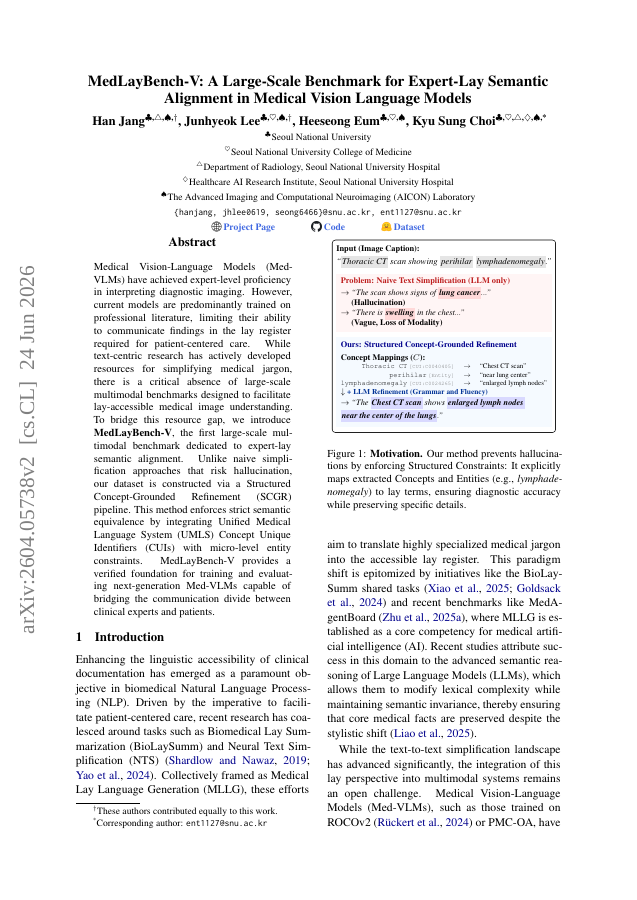
Medical Vision-Language Models (Med-VLMs) have achieved expert-level proficiency in interpreting diagnostic imaging. However, current models are predominantly trained on professional literature, limiting their ability to communicate findings in the lay register required for patient-centered care. While text-centric research has actively developed resources for simplifying medical jargon, there is a critical absence of large-scale multimodal benchmarks designed to facilitate lay-accessible medical image understanding. To bridge this resource gap, we introduce MedLayBench-V, the first large-scale multimodal benchmark dedicated to expert-lay semantic alignment. Unlike naive simplification approaches that risk hallucination, our dataset is constructed via a Structured Concept-Grounded Refinement (SCGR) pipeline. This method enforces strict semantic equivalence by integrating Unified Medical Language System (UMLS) Concept Unique Identifiers (CUIs) with micro-level entity constraints. MedLayBench-V provides a verified foundation for training and evaluating next-generation Med-VLMs capable of bridging the communication divide between clinical experts and patients.
MedLayBench-V: A Large-Scale Benchmark for Expert-Lay Semantic Alignment in Medical Vision Language Models
Medical Vision-Language Models (Med-VLMs) have achieved expert-level proficiency in interpreting diagnostic imaging. However, current models are predominantly trained on professional literature, limiting their ability to communicate findings in the lay register required for…
- Preview
- Year
- 2026
- Hosting
- Abstract onlyARXIV-DEFAULT
Cite
Notes
Only stored in your browser.
Attribution
- Abstract & full text
- arxiv.org/abs/2604.05738ARXIV-DEFAULT
- TL;DR
- Semantic Scholar