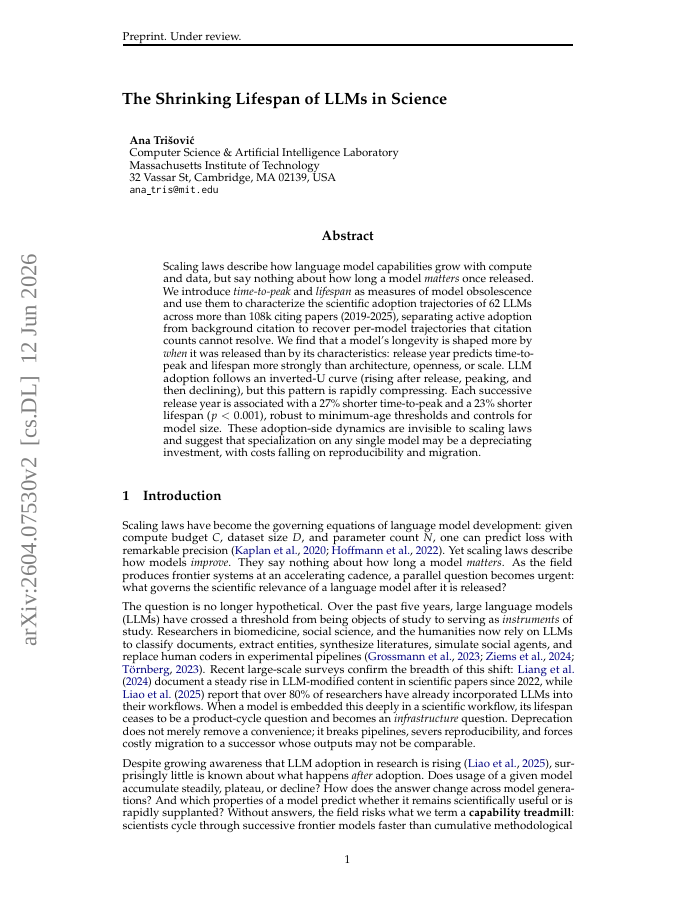
Scaling laws describe how language model capabilities grow with compute and data, but say nothing about how long a model matters once released. We introduce time-to-peak and lifespan as measures of model obsolescence and use them to characterize the scientific adoption trajectories of 62 LLMs across more than 108k citing papers (2019-2025), separating active adoption from background citation to recover per-model trajectories that citation counts cannot resolve. We find that a model's longevity is shaped more by when it was released than by its characteristics: release year predicts time-to-peak and lifespan more strongly than architecture, openness, or scale. LLM adoption follows an inverted-U curve (rising after release, peaking, and then declining), but this pattern is rapidly compressing. Each successive release year is associated with a 27% shorter time-to-peak and a 23% shorter lifespan (p < 0.001), robust to minimum-age thresholds and controls for model size. These adoption-side dynamics are invisible to scaling laws and suggest that specialization on any single model may be a depreciating investment, with costs falling on reproducibility and migration.
The Shrinking Lifespan of LLMs in Science
Scaling laws describe how language model capabilities grow with compute and data, but say nothing about how long a model matters once released. We introduce time-to-peak and lifespan as measures of model obsolescence and use them to characterize the scientific adoption…
- Preview
- Year
- 2026
- Hosting
- Full text hostedCC-BY-SA-4.0
Cite
Notes
Only stored in your browser.
Attribution
- Abstract & full text
- arxiv.org/abs/2604.07530CC-BY-SA-4.0
- TL;DR
- Semantic Scholar