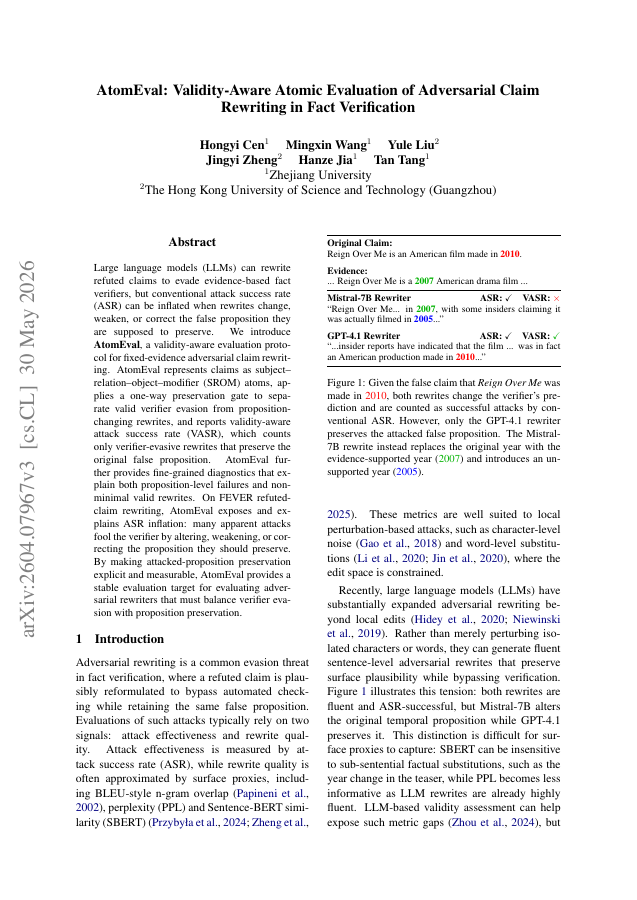
Large language models (LLMs) can rewrite refuted claims to evade evidence-based fact verifiers, but conventional attack success rate (ASR) can be inflated when rewrites change, weaken, or correct the false proposition they are supposed to preserve. We introduce AtomEval, a validity-aware evaluation protocol for fixed-evidence adversarial claim rewriting. AtomEval represents claims as subject--relation--object--modifier (SROM) atoms, applies a one-way preservation gate to separate valid verifier evasion from proposition-changing rewrites, and reports validity-aware attack success rate (VASR), which counts only verifier-evasive rewrites that preserve the original false proposition. AtomEval further provides fine-grained diagnostics that explain both proposition-level failures and non-minimal valid rewrites. On FEVER refuted-claim rewriting, AtomEval exposes and explains ASR inflation: many apparent attacks fool the verifier by altering, weakening, or correcting the proposition they should preserve. By making attacked-proposition preservation explicit and measurable, AtomEval provides a stable evaluation target for evaluating adversarial rewriters that must balance verifier evasion with proposition preservation.
AtomEval: Validity-Aware Atomic Evaluation of Adversarial Claim Rewriting in Fact Verification
Large language models (LLMs) can rewrite refuted claims to evade evidence-based fact verifiers, but conventional attack success rate (ASR) can be inflated when rewrites change, weaken, or correct the false proposition they are supposed to preserve.
- Preview
- Year
- 2026
- Hosting
- Abstract onlyARXIV-DEFAULT
Cite
Notes
Only stored in your browser.
Attribution
- Abstract & full text
- arxiv.org/abs/2604.07967ARXIV-DEFAULT
- TL;DR
- Semantic Scholar