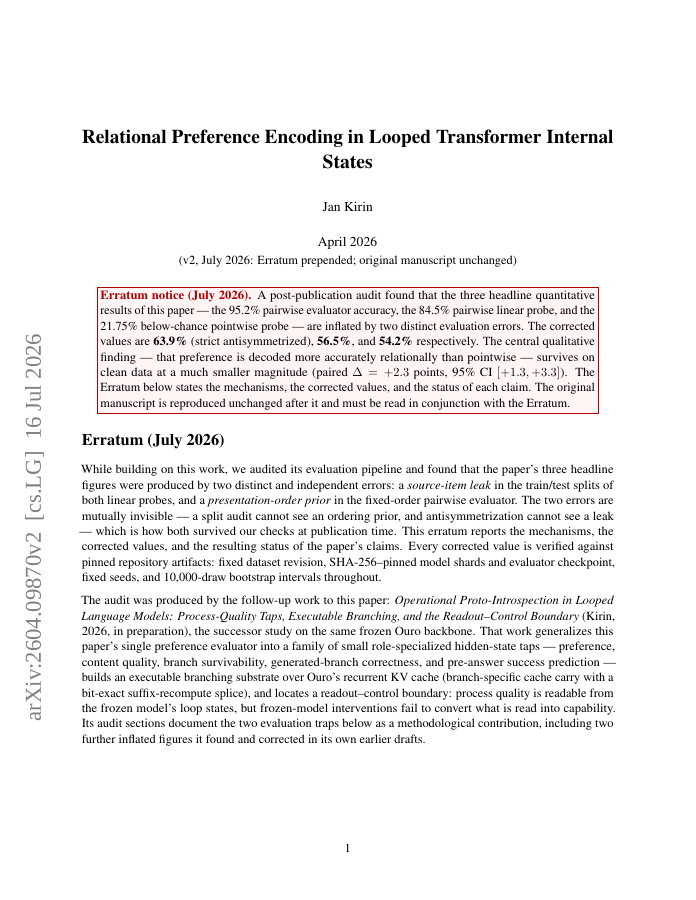
We investigate how looped transformers encode human preference, training lightweight evaluator heads on frozen Ouro-2.6B loop-iteration states on Anthropic HH-RLHF. v2: an erratum is prepended; the original manuscript is unchanged. A post-publication audit found the three headline results inflated by two independent evaluation errors. The 95.2% pairwise evaluator accuracy is a canonical-ordering artifact: the data were correctly split, but the evaluator learned to prefer the first-presented argument; its strict antisymmetrized accuracy on the full 8,552-pair test set is 63.9%. The 84.5% pairwise probe and the below-chance 21.75% pointwise probe were source-item leaks (orientation rows and pair partners crossing the train/test split); corrected pair-disjoint values are 56.5% and 54.2% -- above chance, so the "inverted polarity" finding is withdrawn. The central finding survives at much smaller magnitude: preference is decoded more accurately relationally than pointwise (paired +2.3 points, 95% CI [+1.3, +3.3]), and the antisymmetrized evaluator still beats the linear probe, but no corrected readout rivals end-to-end reward models. The methodological findings stand (constant-output degeneracy, flip test, swap-protocol metric deflation), with one correction: antisymmetrized accuracy, not antisymmetry correlation, certifies relational discrimination. The two errors are mutually invisible -- a split audit cannot see an ordering prior, antisymmetrization cannot see a leak -- so both checks are required. Full audit in the follow-up work (Kirin, 2026, in preparation).
Relational Preference Encoding in Looped Transformer Internal States
We investigate how looped transformers encode human preference, training lightweight evaluator heads on frozen Ouro-2.6B loop-iteration states on Anthropic HH-RLHF. v2: an erratum is prepended; the original manuscript is unchanged.
- Preview
- Year
- 2026
- Hosting
- Full text hostedCC-BY-4.0
Cite
Notes
Only stored in your browser.
Attribution
- Abstract & full text
- arxiv.org/abs/2604.09870CC-BY-4.0
- TL;DR
- Semantic Scholar