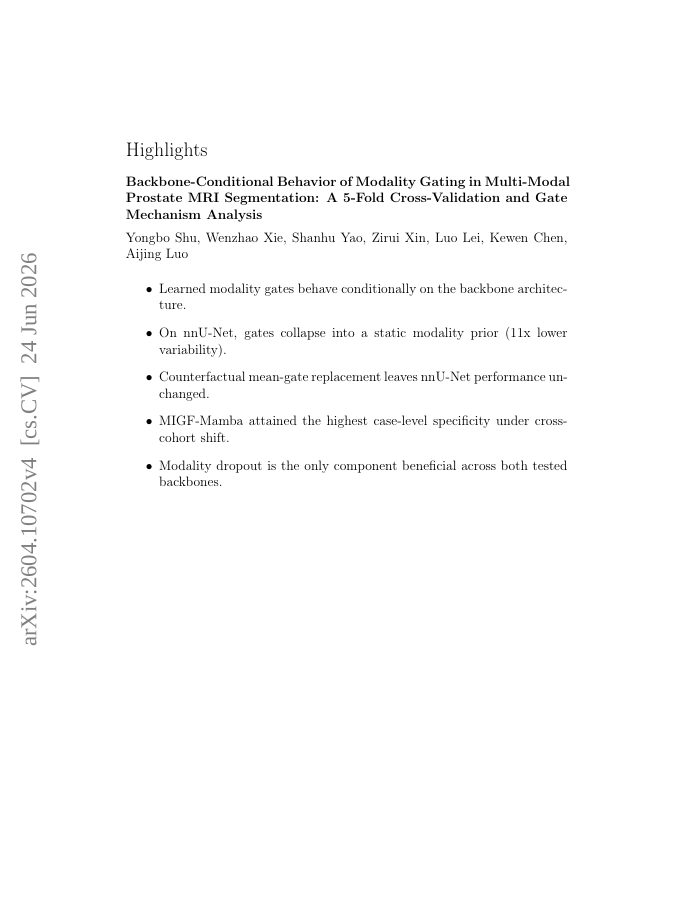
Robust segmentation of clinically significant prostate cancer (csPCa) on multi-parametric MRI must tolerate frequent degradation of its most informative diffusion sequences. Multi-modal fusion commonly employs learned modality gating under the assumption that gates implement per-sample modality quality routing -- rarely tested directly. We ask how gating behaves across backbone architectures. We systematically analyze modality-isolated gated fusion (MIGF) for csPCa segmentation on two backbones (nnU-Net and Mamba) using PI-CAI (n=1500), with cross-cohort validation on Prostate158 (n=158): a factorial ablation over gating, modality dropout, and deep supervision under 5-fold cross-validation (180 trained models), plus a gate-weight and counterfactual analysis of 30 trained gating models. Modality gating is backbone-conditional. On nnU-Net, adding gating reduces the ranking score (marginal effect -0.037; gating configurations p<0.05), whereas on Mamba the gating-plus-dropout configuration improves it (+0.024, p=0.037). Gate-weight analysis explains this: nnU-Net gates collapse into a near-static modality prior (across-case SD 0.0033), while Mamba gates retain sample-dependent variation (0.0365, 11x larger, non-overlapping); replacing per-sample gates with their training-set mean leaves nnU-Net unchanged but degrades Mamba. Modality dropout is the only component beneficial on both backbones. Under cross-cohort shift, convolutional backbones collapse to case-level specificity near zero, whereas Mamba retains it (MIGF-Mamba highest, 0.31). Learned modality gates do not universally perform per-sample quality routing; their effective behavior is conditional on the backbone's inherent modality awareness. Among tested configurations, MIGF-Mamba is the most cross-cohort robust, and training-time modality dropout is the only component beneficial across both backbones.
Backbone-Conditional Behavior of Modality Gating in Multi-Modal Prostate MRI Segmentation: A 5-Fold Cross-Validation and Gate Mechanism Analysis
Robust segmentation of clinically significant prostate cancer (csPCa) on multi-parametric MRI must tolerate frequent degradation of its most informative diffusion sequences.
- Preview
- Year
- 2026
- Hosting
- Full text hostedCC-BY-4.0
Cite
Notes
Only stored in your browser.
Attribution
- Abstract & full text
- arxiv.org/abs/2604.10702CC-BY-4.0
- TL;DR
- Semantic Scholar