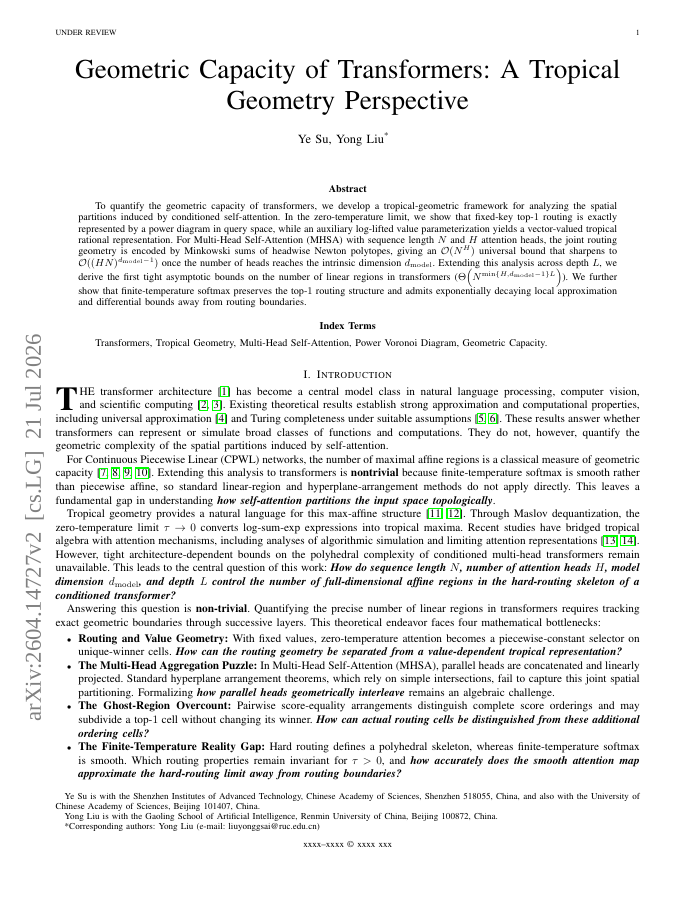
To quantify the geometric capacity of transformers, we develop a tropical-geometric framework for analyzing the spatial partitions induced by conditioned self-attention. In the zero-temperature limit, we show that fixed-key top-1 routing is exactly represented by a power diagram in query space, while an auxiliary log-lifted value parameterization yields a vector-valued tropical rational representation. For Multi-Head Self-Attention (MHSA) with sequence length N and H attention heads, the joint routing geometry is encoded by Minkowski sums of headwise Newton polytopes, giving an O(N^H) universal bound that sharpens to O((HN)^{d_{model}-1}) once the number of heads reaches the intrinsic dimension d_{model}. Extending this analysis across depth L, we derive the first tight asymptotic bounds on the number of linear regions in transformers (Θ!\left(N^{\min{H,d_{model}-1}L}\right)). We further show that finite-temperature softmax preserves the top-1 routing structure and admits exponentially decaying local approximation and differential bounds away from routing boundaries.
Geometric Capacity of Transformers: A Tropical Geometry Perspective
To quantify the geometric capacity of transformers, we develop a tropical-geometric framework for analyzing the spatial partitions induced by conditioned self-attention.
- Preview
- Year
- 2026
- Hosting
- Full text hostedCC-BY-4.0
Cite
Notes
Only stored in your browser.
Attribution
- Abstract & full text
- arxiv.org/abs/2604.14727CC-BY-4.0
- TL;DR
- Semantic Scholar