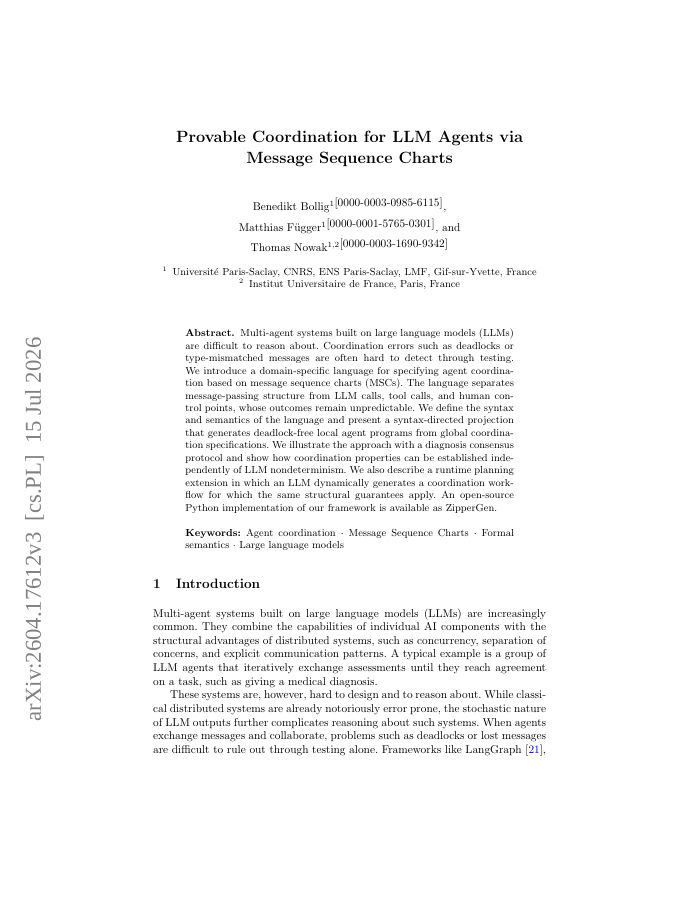
Multi-agent systems built on large language models (LLMs) are difficult to reason about. Coordination errors such as deadlocks or type-mismatched messages are often hard to detect through testing. We introduce a domain-specific language for specifying agent coordination based on message sequence charts (MSCs). The language separates message-passing structure from LLM calls, tool calls, and human control points, whose outcomes remain unpredictable. We define the syntax and semantics of the language and present a syntax-directed projection that generates deadlock-free local agent programs from global coordination specifications. We illustrate the approach with a diagnosis consensus protocol and show how coordination properties can be established independently of LLM nondeterminism. We also describe a runtime planning extension in which an LLM dynamically generates a coordination workflow for which the same structural guarantees apply. An open-source Python implementation of our framework is available as ZipperGen.
Provable Coordination for LLM Agents via Message Sequence Charts
Multi-agent systems built on large language models (LLMs) are difficult to reason about. Coordination errors such as deadlocks or type-mismatched messages are often hard to detect through testing.
- Preview
- Year
- 2026
- Hosting
- Full text hostedCC-BY-4.0
Cite
Notes
Only stored in your browser.
Attribution
- Abstract & full text
- arxiv.org/abs/2604.17612CC-BY-4.0
- TL;DR
- Semantic Scholar