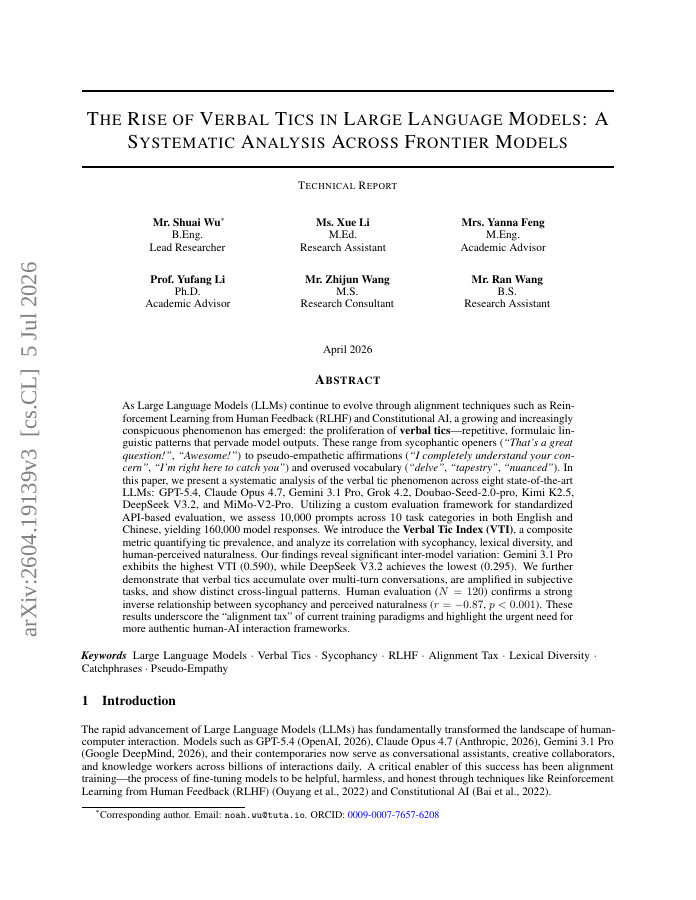
As Large Language Models (LLMs) continue to evolve through alignment techniques such as Reinforcement Learning from Human Feedback (RLHF) and Constitutional AI, a growing and increasingly conspicuous phenomenon has emerged: the proliferation of verbal tics--repetitive, formulaic linguistic patterns that pervade model outputs. These range from sycophantic openers ("That's a great question!", "Awesome!") to pseudo-empathetic affirmations ("I completely understand your concern", "I'm right here to catch you") and overused vocabulary ("delve", "tapestry", "nuanced"). In this paper, we present a systematic analysis of the verbal tic phenomenon across eight state-of-the-art LLMs: GPT-5.5, Claude Opus 4.8, Gemini 3.1 Pro, Grok 4.3, Doubao-Seed-2.1-pro, Kimi K2.6, DeepSeek V4 Pro, and GLM-5.2. Utilizing a custom evaluation framework for standardized API-based evaluation, we assess 10,000 prompts across 10 task categories in both English and Chinese, yielding 160,000 model responses. We introduce the Verbal Tic Index (VTI), a composite metric quantifying tic prevalence, and analyze its correlation with sycophancy, lexical diversity, and human-perceived naturalness. Our findings reveal significant inter-model variation: Gemini 3.1 Pro exhibits the highest VTI (0.590), while DeepSeek V4 Pro achieves the lowest (0.295). We further demonstrate that verbal tics accumulate over multi-turn conversations, are amplified in subjective tasks, and show distinct cross-lingual patterns. Human evaluation (N = 120) confirms a strong inverse relationship between sycophancy and perceived naturalness (r = -0.87, p < 0.001). These results underscore the "alignment tax" of current training paradigms and highlight the urgent need for more authentic human-AI interaction frameworks.
The Rise of Verbal Tics in Large Language Models: A Systematic Analysis Across Frontier Models
As Large Language Models (LLMs) continue to evolve through alignment techniques such as Reinforcement Learning from Human Feedback (RLHF) and Constitutional AI, a growing and increasingly conspicuous phenomenon has emerged: the proliferation of verbal tics--repetitive, formulaic…
- Preview
- Year
- 2026
- Hosting
- Full text hostedCC-BY-4.0
Cite
Notes
Only stored in your browser.
Attribution
- Abstract & full text
- arxiv.org/abs/2604.19139CC-BY-4.0
- TL;DR
- Semantic Scholar