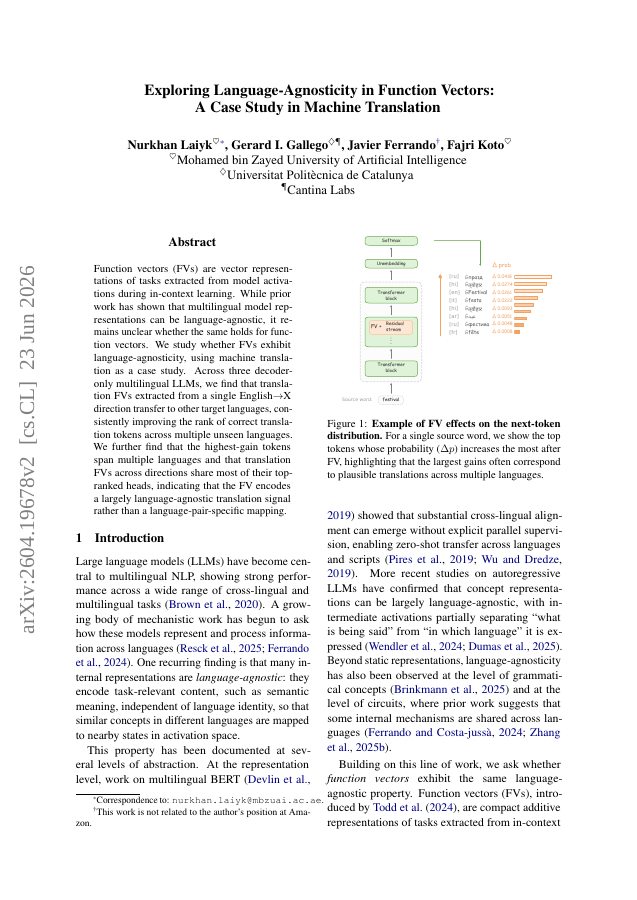
Function vectors (FVs) are vector representations of tasks extracted from model activations during in-context learning. While prior work has shown that multilingual model representations can be language-agnostic, it remains unclear whether the same holds for function vectors. We study whether FVs exhibit language-agnosticity, using machine translation as a case study. Across three decoder-only multilingual LLMs, we find that translation FVs extracted from a single English\toX direction transfer to other target languages, consistently improving the rank of correct translation tokens across multiple unseen languages. We further find that the highest-gain tokens span multiple languages and that translation FVs across directions share most of their top-ranked heads, indicating that the FV encodes a largely language-agnostic translation signal rather than a language-pair-specific mapping.
Exploring Language-Agnosticity in Function Vectors: A Case Study in Machine Translation
Function vectors (FVs) are vector representations of tasks extracted from model activations during in-context learning. While prior work has shown that multilingual model representations can be language-agnostic, it remains unclear whether the same holds for function vectors.
- Preview
- Year
- 2026
- Hosting
- Full text hostedCC-BY-4.0
Cite
Notes
Only stored in your browser.
Attribution
- Abstract & full text
- arxiv.org/abs/2604.19678CC-BY-4.0
- TL;DR
- Semantic Scholar