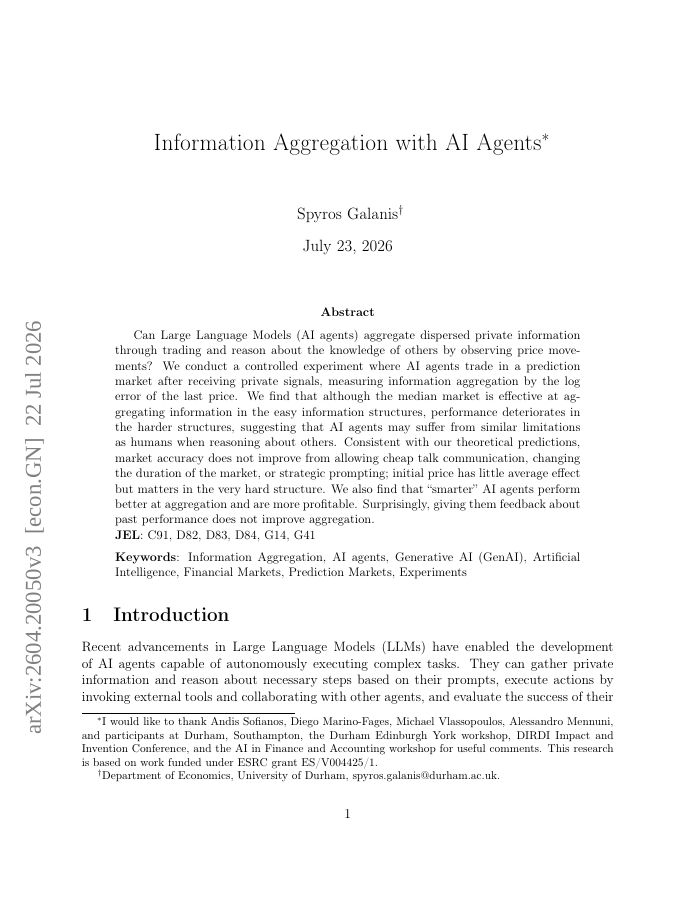
Can Large Language Models (AI agents) aggregate dispersed private information through trading and reason about the knowledge of others by observing price movements? We conduct a controlled experiment where AI agents trade in a prediction market after receiving private signals, measuring information aggregation by the log error of the last price. We find that although the median market is effective at aggregating information in the easy information structures, performance deteriorates in the harder structures, suggesting that AI agents may suffer from similar limitations as humans when reasoning about others. Consistent with our theoretical predictions, market accuracy does not improve from allowing cheap talk communication, changing the duration of the market, or strategic prompting; initial price has little average effect but matters in the very hard structure. We also find that "smarter" AI agents perform better at aggregation and are more profitable. Surprisingly, giving them feedback about past performance does not improve aggregation.
Information Aggregation with AI Agents
Can Large Language Models (AI agents) aggregate dispersed private information through trading and reason about the knowledge of others by observing price movements? We conduct a controlled experiment where AI agents trade in a prediction market after receiving private signals,…
- Preview
- Year
- 2026
- Hosting
- Full text hostedCC-BY-4.0
Cite
Notes
Only stored in your browser.
Attribution
- Abstract & full text
- arxiv.org/abs/2604.20050CC-BY-4.0
- TL;DR
- Semantic Scholar