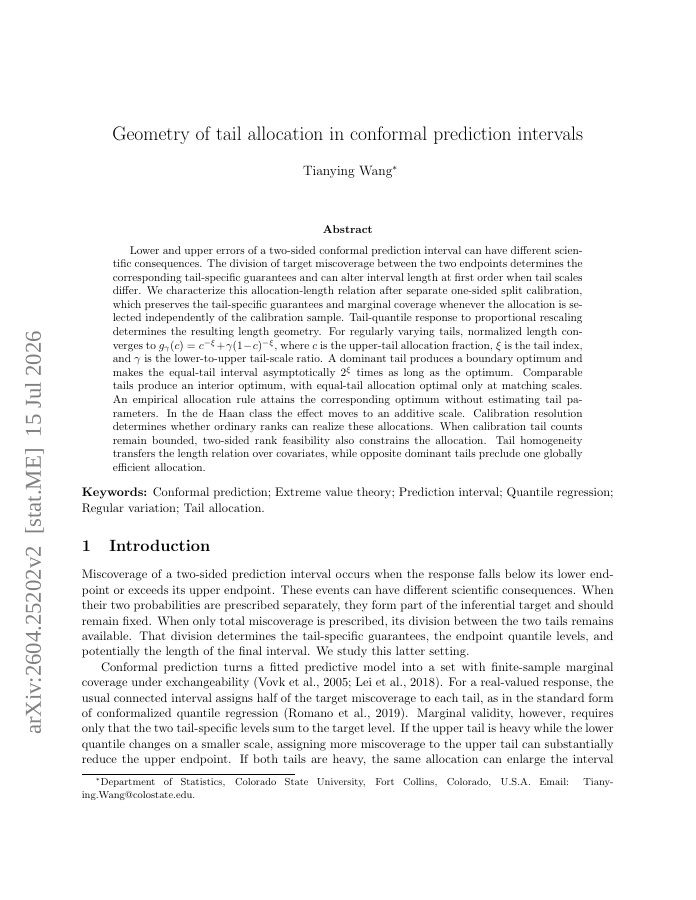
Lower and upper errors of a two-sided conformal prediction interval can have different scientific consequences. The division of target miscoverage between the two endpoints determines the corresponding tail-specific guarantees and can alter interval length at first order when tail scales differ. We characterize this allocation-length relation after separate one-sided split calibration, which preserves the tail-specific guarantees and marginal coverage whenever the allocation is selected independently of the calibration sample. Tail-quantile response to proportional rescaling determines the resulting length geometry. For regularly varying tails, normalized length converges to g_γ(c)=c^{-ξ}+γ(1-c)^{-ξ}, where c is the upper-tail allocation fraction, ξ is the tail index, and γ is the lower-to-upper tail-scale ratio. A dominant tail produces a boundary optimum and makes the equal-tail interval asymptotically 2^ξ times as long as the optimum. Comparable tails produce an interior optimum, with equal-tail allocation optimal only at matching scales. An empirical allocation rule attains the corresponding optimum without estimating tail parameters. In the de Haan class the effect moves to an additive scale. Calibration resolution determines whether ordinary ranks can realize these allocations. When calibration tail counts remain bounded, two-sided rank feasibility also constrains the allocation. Tail homogeneity transfers the length relation over covariates, while opposite dominant tails preclude one globally efficient allocation.
Geometry of tail allocation in conformal prediction intervals
Lower and upper errors of a two-sided conformal prediction interval can have different scientific consequences. The division of target miscoverage between the two endpoints determines the corresponding tail-specific guarantees and can alter interval length at first order when…
- Preview
- Year
- 2026
- Hosting
- Abstract onlyARXIV-DEFAULT
Cite
Notes
Only stored in your browser.
Attribution
- Abstract & full text
- arxiv.org/abs/2604.25202ARXIV-DEFAULT
- TL;DR
- Semantic Scholar