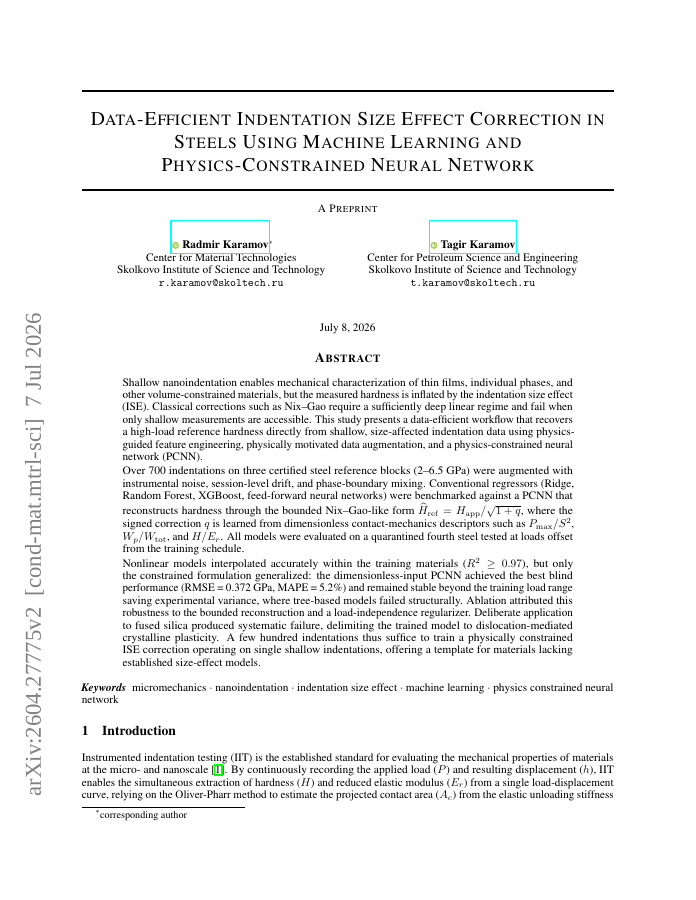
Shallow nanoindentation enables mechanical characterization of thin films, individual phases, and other volume-constrained materials, but the measured hardness is inflated by the indentation size effect (ISE). Classical corrections such as Nix-Gao require a deep linear regime and fail when only shallow measurements are accessible. We present a data-efficient workflow that recovers a high-load reference hardness directly from shallow, size-affected indentation data. Over 700 indentations on three certified steel reference blocks (2-6.5 GPa) were expanded by physics-guided augmentation and used to train conventional regressors (Ridge, Random Forest, XGBoost, neural networks) and a physics-constrained neural network (PCNN) that reconstructs hardness through the bounded form H_ref = H_app/sqrt(1+q), with the signed correction q learned from dimensionless contact-mechanics descriptors (P_max/S^2, W_p/W_tot, H/E_r). On a quarantined fourth steel tested at loads offset from the training schedule, only the constrained formulation generalized: the dimensionless-input PCNN achieved RMSE = 0.372 GPa and MAPE = 5.2%, and remained stable beyond the training load range, where tree-based models failed structurally. Ablation attributed this robustness to the bounded reconstruction and a load-independence regularizer. Deliberate application to fused silica produced systematic failure, delimiting the method to dislocation-mediated crystalline plasticity. A few hundred laboratory indentations thus suffice to train a physically constrained ISE correction operating on single shallow indentations, offering a template for materials lacking analytical size-effect models.
Data-Efficient Indentation Size Effect Correction in Steels Using Machine Learning and Physics-Constrained Neural Network
Shallow nanoindentation enables mechanical characterization of thin films, individual phases, and other volume-constrained materials, but the measured hardness is inflated by the indentation size effect (ISE).
- Preview
- Year
- 2026
- Hosting
- Abstract onlyARXIV-DEFAULT
Cite
Notes
Only stored in your browser.
Attribution
- Abstract & full text
- arxiv.org/abs/2604.27775ARXIV-DEFAULT
- TL;DR
- Semantic Scholar