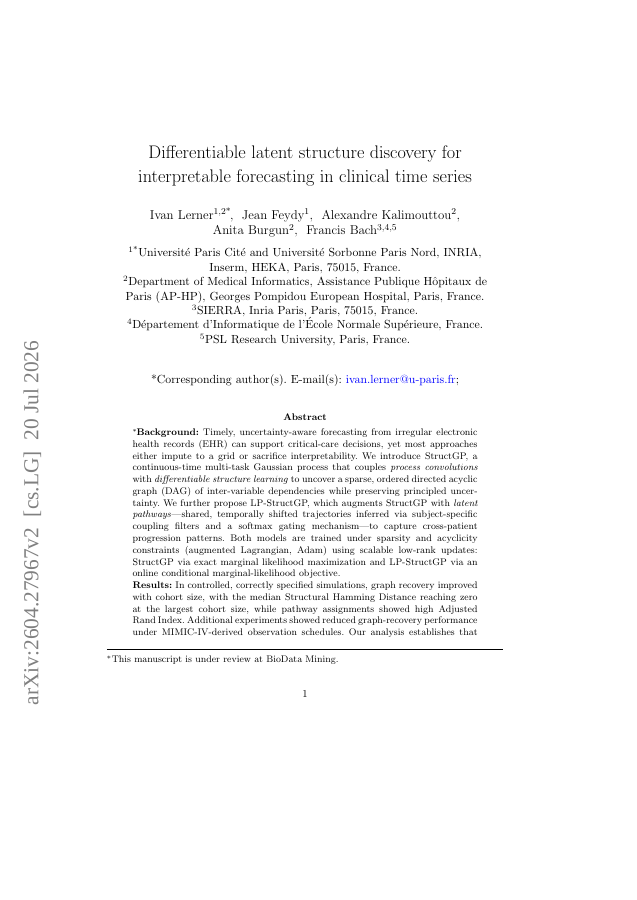
Background: We introduce StructGP, a continuous-time multi-task Gaussian process that couples process convolutions with differentiable structure learning to uncover a sparse, ordered directed acyclic graph (DAG) of inter-variable dependencies while preserving principled uncertainty. We further propose LP-StructGP, which augments StructGP with latent pathways-shared, temporally shifted trajectories inferred via subject-specific coupling filters and a softmax gating mechanism-to capture cross-patient progression patterns. Both models are trained under sparsity and acyclicity constraints using scalable low-rank updates using likelihood-based objectives. Results: In simulations, graph recovery improved with cohort size, with the median Structural Hamming Distance reaching zero at the largest cohort size, while pathway assignments showed high Adjusted Rand Index. Our analysis establishes that the ordered StructGP graph is identifiable from the population marginal likelihood. On a MIMIC-IV septic shock cohort (n=1,008; norepinephrine, creatinine, mean blood pressure), StructGP improves short-horizon (6 h) forecasting over independent-task baselines (average RMSE 0.68 [95% CI: 0.63-0.74] vs. 0.88 [0.83-0.94]) and, with 15 additional inputs, markedly outperforms unstructured kernels (0.63 [0.58-0.69] vs. 3.02 [2.85-3.18]) with superior calibration (coverage 0.96 vs. 0.84). For long horizons (up to 6 days), LP-StructGP further reduces error for creatinine (RMSE 0.95 [0.88-1.03] vs. 1.17 [1.08-1.25]) and improves overall coverage (0.93 [0.93-0.94] vs. 0.91 [0.91-0.92]). On the PhysioNet Challenge, StructGP attains competitive accuracy (MAE 3.72e-2) relative to a strong published graph neural model. Conclusion: These results show that structured process convolutions with latent pathways deliver interpretable, scalable, and well-calibrated forecasting for irregular clinical time series.
Differentiable latent structure discovery for interpretable forecasting in clinical time series
Background: We introduce StructGP, a continuous-time multi-task Gaussian process that couples process convolutions with differentiable structure learning to uncover a sparse, ordered directed acyclic graph (DAG) of inter-variable dependencies while preserving principled…
- Preview
- Year
- 2026
- Hosting
- Full text hostedCC-BY-4.0
Cite
Notes
Only stored in your browser.
Attribution
- Abstract & full text
- arxiv.org/abs/2604.27967CC-BY-4.0
- TL;DR
- Semantic Scholar