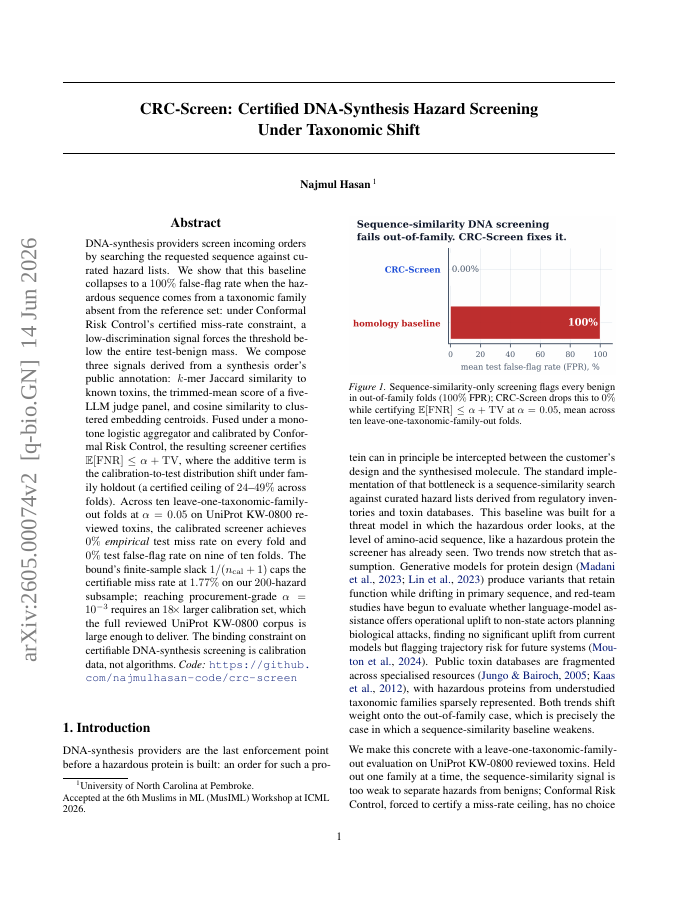
DNA-synthesis providers screen incoming orders by searching the requested sequence against curated hazard lists. We show that this baseline collapses to a 100% false-flag rate when the hazardous sequence comes from a taxonomic family absent from the reference set: under Conformal Risk Control's certified miss-rate constraint, a low-discrimination signal forces the threshold below the entire test-benign mass. We compose three signals derived from a synthesis order's public annotation: k-mer Jaccard similarity to known toxins, the trimmed-mean score of a five-LLM judge panel, and cosine similarity to clustered embedding centroids. Fused under a monotone logistic aggregator and calibrated by Conformal Risk Control, the resulting screener certifies \mathbb{E}[FNR] \le α+ TV, where the additive term is the calibration-to-test distribution shift under family holdout (a certified ceiling of 24-49% across folds). Across ten leave-one-taxonomic-family-out folds at α=0.05 on UniProt KW-0800 reviewed toxins, the calibrated screener achieves 0% empirical test miss rate on every fold and 0% test false-flag rate on nine of ten folds. The bound's finite-sample slack 1/(n_{cal}+1) caps the certifiable miss rate at 1.77% on our 200-hazard subsample; reaching procurement-grade α=10^{-3} requires an 18\times larger calibration set, which the full reviewed UniProt KW-0800 corpus is large enough to deliver. The binding constraint on certifiable DNA-synthesis screening is calibration data, not algorithms. Code: https://github.com/najmulhasan-code/crc-screen
CRC-Screen: Certified DNA-Synthesis Hazard Screening Under Taxonomic Shift
DNA-synthesis providers screen incoming orders by searching the requested sequence against curated hazard lists. We show that this baseline collapses to a 100% false-flag rate when the hazardous sequence comes from a taxonomic family absent from the reference set: under…
- Preview
- Year
- 2026
- Hosting
- Full text hostedCC-BY-4.0
Cite
Notes
Only stored in your browser.
Attribution
- Abstract & full text
- arxiv.org/abs/2605.00074CC-BY-4.0
- TL;DR
- Semantic Scholar