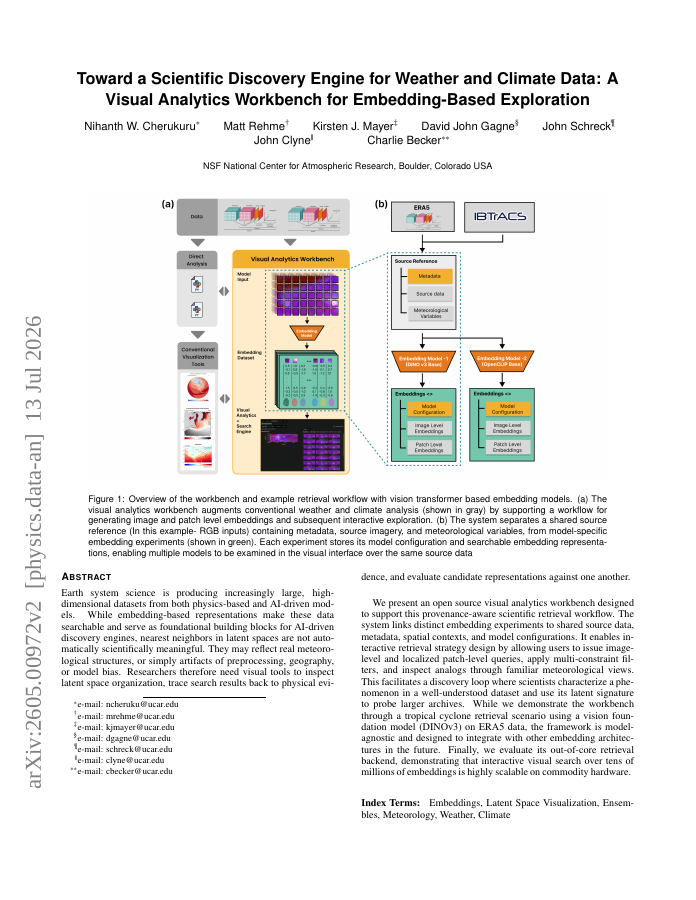
Earth system science is producing increasingly large, high-dimensional datasets from both physics-based and AI-driven models. While embedding-based representations make these data searchable and serve as foundational building blocks for AI-driven discovery engines, nearest neighbors in latent spaces are not automatically scientifically meaningful. They may reflect real meteorological structures, or simply artifacts of preprocessing, geography, or model bias. Researchers therefore need visual tools to inspect latent space organization, trace search results back to physical evidence, and evaluate candidate representations against one another. We present an open source visual analytics workbench designed to support this provenance-aware scientific retrieval workflow. The system links distinct embedding experiments to shared source data, metadata, spatial contexts, and model configurations. It enables interactive retrieval strategy design by allowing users to issue image-level and localized patch-level queries, apply multi-constraint filters, and inspect analogs through familiar meteorological views. This facilitates a discovery loop where scientists characterize a phenomenon in a well-understood dataset and use its latent signature to probe larger archives. While we demonstrate the workbench through a tropical cyclone retrieval scenario using a vision foundation model (DINOv3) on ERA5 data, the framework is model-agnostic and designed to integrate with other embedding architectures in the future. Finally, we evaluate its out-of-core retrieval backend, demonstrating that interactive visual search over tens of millions of embeddings is highly scalable on commodity hardware.
Toward a Scientific Discovery Engine for Weather and Climate Data: A Visual Analytics Workbench for Embedding-Based Exploration
Earth system science is producing increasingly large, high-dimensional datasets from both physics-based and AI-driven models. While embedding-based representations make these data searchable and serve as foundational building blocks for AI-driven discovery engines, nearest…
- Preview
- Year
- 2026
- Hosting
- Full text hostedCC-BY-4.0
Cite
Notes
Only stored in your browser.
Attribution
- Abstract & full text
- arxiv.org/abs/2605.00972CC-BY-4.0
- TL;DR
- Semantic Scholar