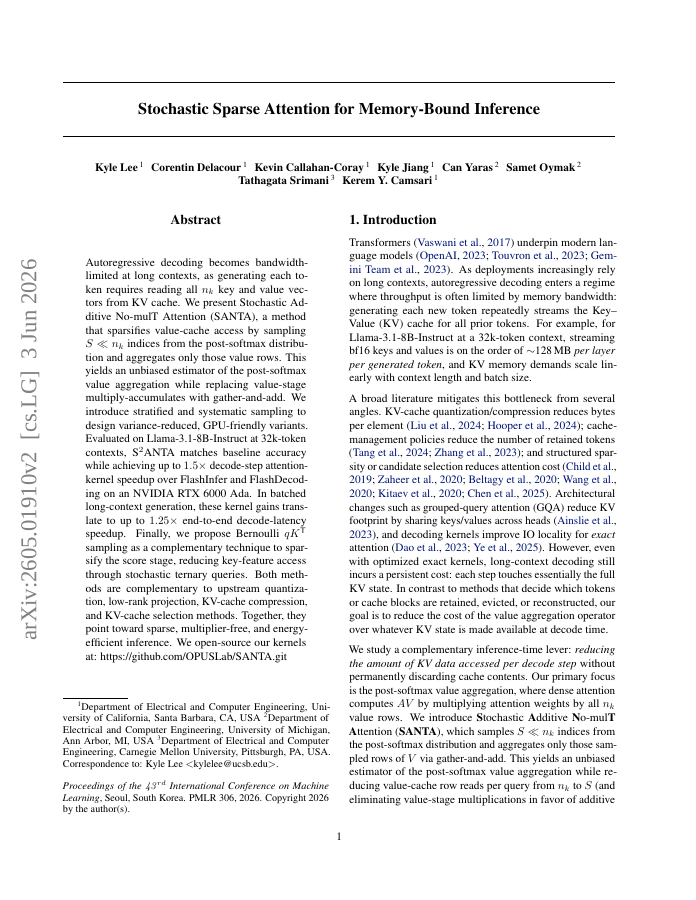
Autoregressive decoding becomes bandwidth-limited at long contexts, as generating each token requires reading all n_k key and value vectors from KV cache. We present Stochastic Additive No-mulT Attention (SANTA), a method that sparsifies value-cache access by sampling S \ll n_k indices from the post-softmax distribution and aggregates only those value rows. This yields an unbiased estimator of the post-softmax value aggregation while replacing value-stage multiply-accumulates with gather-and-add. We introduce stratified and systematic sampling to design variance-reduced, GPU-friendly variants. Evaluated on Llama-3.1-8B-Instruct at 32k-token contexts, S^2ANTA matches baseline accuracy while achieving up to 1.5\times decode-step attention-kernel speedup over FlashInfer and FlashDecoding on an NVIDIA RTX 6000 Ada. In batched long-context generation, these kernel gains translate to up to 1.25\times end-to-end decode-latency speedup. Finally, we propose Bernoulli qK^T sampling as a complementary technique to sparsify the score stage, reducing key-feature access through stochastic ternary queries. Both methods are complementary to upstream quantization, low-rank projection, KV-cache compression, and KV-cache selection methods. Together, they point toward sparse, multiplier-free, and energy-efficient inference. We open-source our kernels at: https://github.com/OPUSLab/SANTA.git
Stochastic Sparse Attention for Memory-Bound Inference
Autoregressive decoding becomes bandwidth-limited at long contexts, as generating each token requires reading all $n_k$ key and value vectors from KV cache. We present Stochastic Additive No-mulT Attention (SANTA), a method that sparsifies value-cache access by sampling $S \ll…
- Preview
- Year
- 2026
- Hosting
- Abstract onlyARXIV-DEFAULT
Cite
Notes
Only stored in your browser.
Attribution
- Abstract & full text
- arxiv.org/abs/2605.01910ARXIV-DEFAULT
- TL;DR
- Semantic Scholar