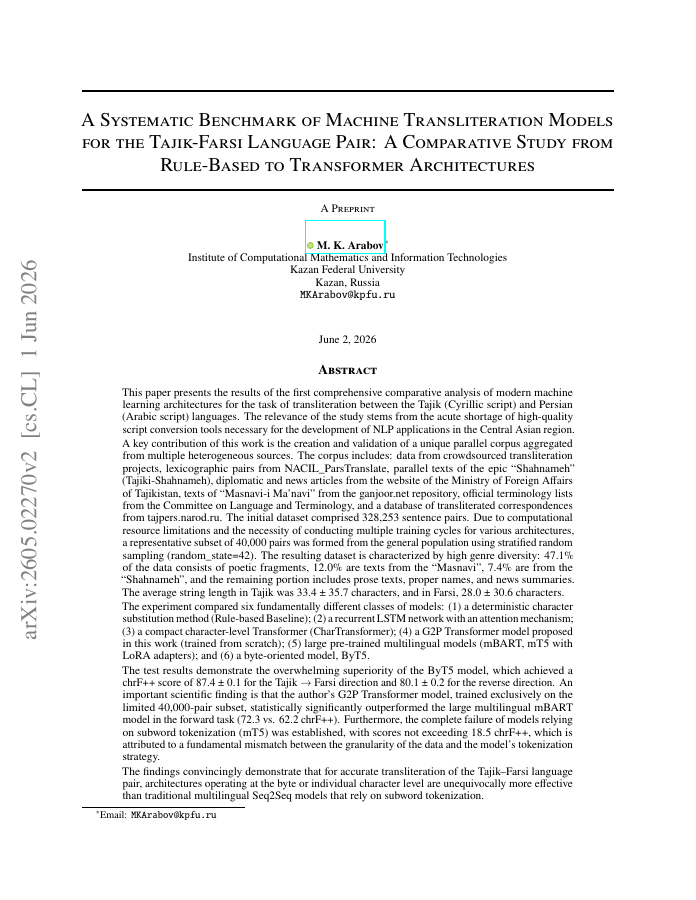
This paper presents the first comprehensive comparative analysis of modern machine learning architectures for transliteration between Tajik (Cyrillic script) and Persian (Arabic script). A key contribution is the creation and validation of a unique parallel corpus aggregated from multiple heterogeneous sources, including crowdsourced projects, lexicographic pairs, parallel texts of "Shahnameh", diplomatic articles, texts of "Masnavi-i Ma'navi", official terminology lists, and transliterated correspondences. The initial dataset comprised 328,253 sentence pairs; a representative subset of 40,000 pairs was formed using stratified random sampling. The experiment compared six classes of models: rule-based baseline, LSTM with attention, character-level Transformer, G2P Transformer (trained from scratch), pre-trained multilingual models (mBART, mT5 with LoRA), and byte-level ByT5. Results demonstrate the overwhelming superiority of ByT5 (chrF++ 87.4 for Tajik to Farsi, 80.1 for reverse). The G2P Transformer significantly outperformed mBART (72.3 vs. 62.2 chrF++) despite limited data. Models using subword tokenization (mT5) failed completely (chrF++ less than 18.5). The findings demonstrate that for accurate transliteration of the Tajik-Farsi pair, architectures operating at the byte or character level are unequivocally more effective than traditional multilingual Seq2Seq models relying on subword tokenization.
A Systematic Benchmark of Machine Transliteration Models for the Tajik-Farsi Language Pair: A Comparative Study from Rule-Based to Transformer Architectures
This paper presents the first comprehensive comparative analysis of modern machine learning architectures for transliteration between Tajik (Cyrillic script) and Persian (Arabic script).
- Preview
- Year
- 2026
- Hosting
- Abstract onlyARXIV-DEFAULT
Cite
Notes
Only stored in your browser.
Attribution
- Abstract & full text
- arxiv.org/abs/2605.02270ARXIV-DEFAULT
- TL;DR
- Semantic Scholar