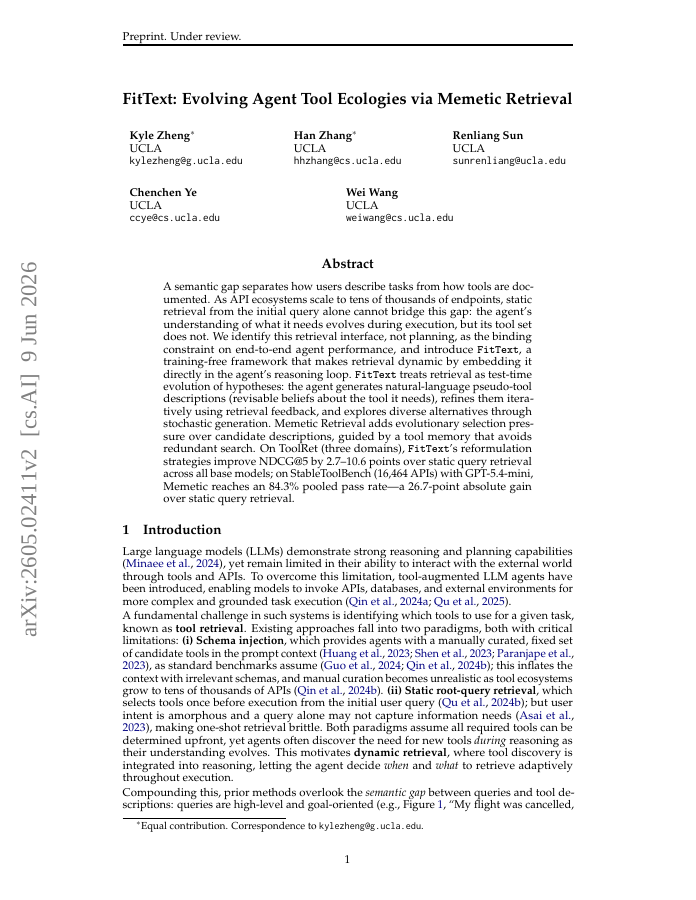
A semantic gap separates how users describe tasks from how tools are documented. As API ecosystems scale to tens of thousands of endpoints, static retrieval from the initial query alone cannot bridge this gap: the agent's understanding of what it needs evolves during execution, but its tool set does not. We identify this retrieval interface, not planning, as the binding constraint on end-to-end agent performance, and introduce FitText, a training-free framework that makes retrieval dynamic by embedding it directly in the agent's reasoning loop. FitText treats retrieval as test-time evolution of hypotheses: the agent generates natural-language pseudo-tool descriptions (revisable beliefs about the tool it needs), refines them iteratively using retrieval feedback, and explores diverse alternatives through stochastic generation. Memetic Retrieval adds evolutionary selection pressure over candidate descriptions, guided by a tool memory that avoids redundant search. On ToolRet (three domains), FitText's reformulation strategies improve NDCG@5 by 2.7 to 10.6 points over static query retrieval across all base models; on StableToolBench (16,464 APIs) with GPT-5.4-mini, Memetic reaches an 84.3% pooled pass rate, a 26.7-point absolute gain over static query retrieval.
FitText: Evolving Agent Tool Ecologies via Memetic Retrieval
A semantic gap separates how users describe tasks from how tools are documented. As API ecosystems scale to tens of thousands of endpoints, static retrieval from the initial query alone cannot bridge this gap: the agent's understanding of what it needs evolves during execution,…
- Preview
- Year
- 2026
- Hosting
- Full text hostedCC-BY-4.0
Cite
Notes
Only stored in your browser.
Attribution
- Abstract & full text
- arxiv.org/abs/2605.02411CC-BY-4.0
- TL;DR
- Semantic Scholar