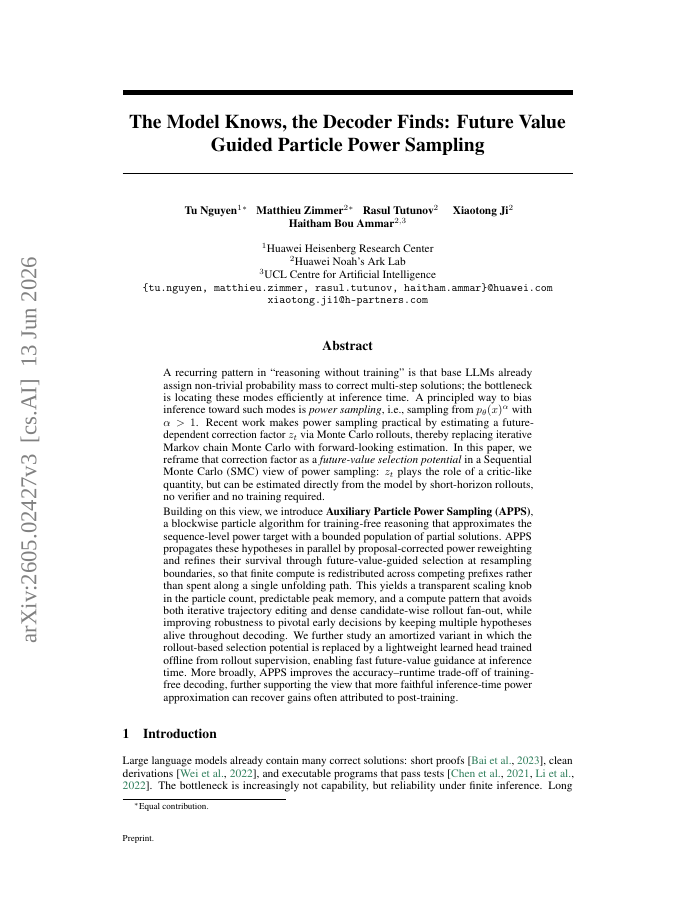
A recurring pattern in "reasoning without training" is that base LLMs already assign non-trivial probability mass to correct multi-step solutions; the bottleneck is locating these modes efficiently at inference time. Power sampling provides a principled way to bias decoding toward such modes by targeting p_theta(x)^alpha with alpha > 1, but practical approximations must account for future-dependent correction factors that determine which prefixes remain promising. We introduce Auxiliary Particle Power Sampling (APPS), a blockwise particle algorithm for approximating the sequence-level power target with a bounded population of partial solutions. APPS propagates hypotheses in parallel using proposal-corrected power reweighting and refines their survival through future-value-guided selection at resampling boundaries. This redistributes finite compute across competing prefixes rather than committing to a single unfolding path, while providing a direct scaling knob in the particle count and predictable peak memory. We instantiate the future-value signal with short-horizon rollouts and also study an amortized variant that replaces rollouts with a lightweight learned selection head. AMore broadly, APPS improves the accuracy--runtime trade-off of training-free decoding, further supporting the view that inference-time power approximation can recover gains often attributed to post-training.
The Model Knows, the Decoder Finds: Future Value Guided Particle Power Sampling
A recurring pattern in "reasoning without training" is that base LLMs already assign non-trivial probability mass to correct multi-step solutions; the bottleneck is locating these modes efficiently at inference time.
- Preview
- Year
- 2026
- Hosting
- Full text hostedCC-BY-4.0
Cite
Notes
Only stored in your browser.
Attribution
- Abstract & full text
- arxiv.org/abs/2605.02427CC-BY-4.0
- TL;DR
- Semantic Scholar