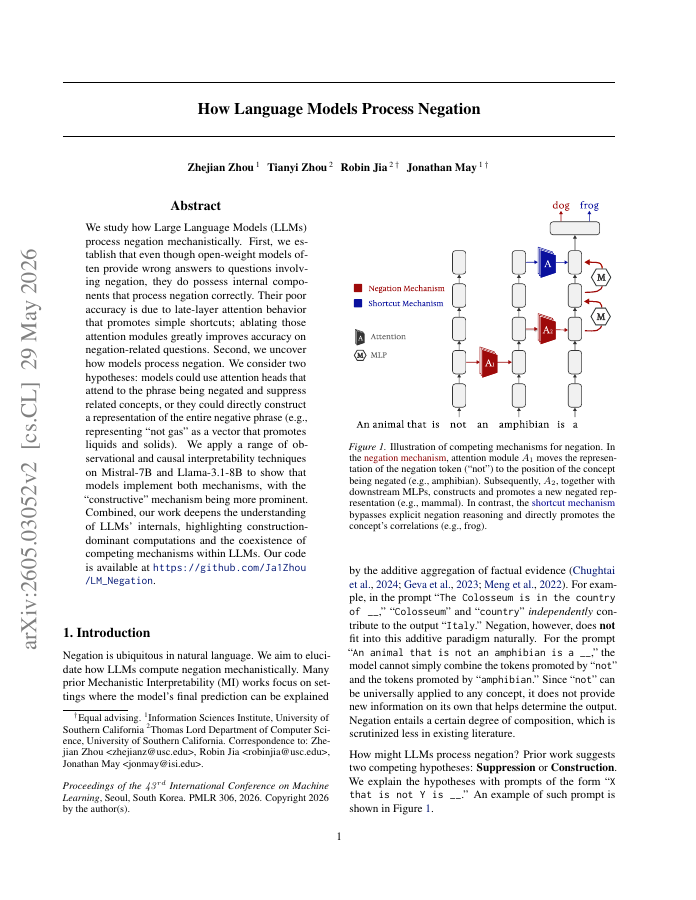
We study how Large Language Models (LLMs) process negation mechanistically. First, we establish that even though open-weight models often provide wrong answers to questions involving negation, they do possess internal components that process negation correctly. Their poor accuracy is due to late-layer attention behavior that promotes simple shortcuts; ablating those attention modules greatly improves accuracy on negation-related questions. Second, we uncover how models process negation. We consider two hypotheses: models could use attention heads that attend to the phrase being negated and suppress related concepts, or they could directly construct a representation of the entire negative phrase (e.g., representing "not gas" as a vector that promotes liquids and solids). We apply a range of observational and causal interpretability techniques on Mistral-7B and Llama-3.1-8B to show that models implement both mechanisms, with the "constructive" mechanism being more prominent. Combined, our work deepens the understanding of LLMs' internals, highlighting construction-dominant computations and the coexistence of competing mechanisms within LLMs.
How Language Models Process Negation
We study how Large Language Models (LLMs) process negation mechanistically. First, we establish that even though open-weight models often provide wrong answers to questions involving negation, they do possess internal components that process negation correctly.
- Preview
- Year
- 2026
- Hosting
- Full text hostedCC-BY-4.0
Cite
Notes
Only stored in your browser.
Attribution
- Abstract & full text
- arxiv.org/abs/2605.03052CC-BY-4.0
- TL;DR
- Semantic Scholar