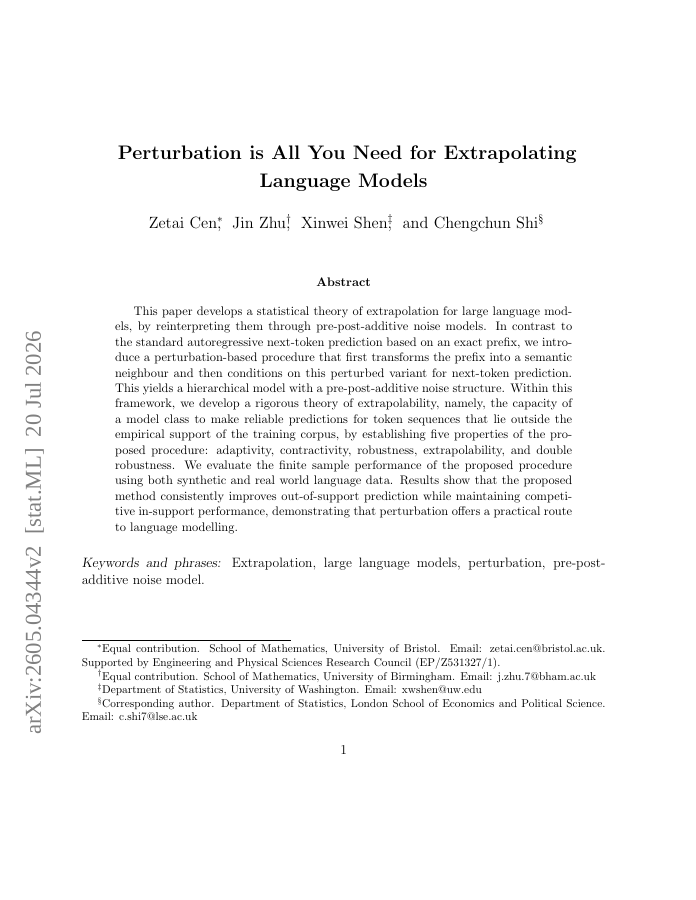
This paper develops a statistical theory of extrapolation for large language models, by reinterpreting them through pre-post-additive noise models. In contrast to the standard autoregressive next-token prediction based on an exact prefix, we introduce a perturbation-based procedure that first transforms the prefix into a semantic neighbour and then conditions on this perturbed variant for next-token prediction. This yields a hierarchical model with a pre-post-additive noise structure. Within this framework, we develop a rigorous theory of extrapolability, namely, the capacity of a model class to make reliable predictions for token sequences that lie outside the empirical support of the training corpus, by establishing five properties of the proposed procedure: adaptivity, contractivity, robustness, extrapolability, and double robustness. We evaluate the finite sample performance of the proposed procedure using both synthetic and real world language data. Results show that the proposed method consistently improves out-of-support prediction while maintaining competitive in-support performance, demonstrating that perturbation offers a practical route to language modelling.
Perturbation is All You Need for Extrapolating Language Models
This paper develops a statistical theory of extrapolation for large language models, by reinterpreting them through pre-post-additive noise models. In contrast to the standard autoregressive next-token prediction based on an exact prefix, we introduce a perturbation-based…
- Preview
- Year
- 2026
- Hosting
- Full text hostedCC-BY-4.0
Cite
Notes
Only stored in your browser.
Attribution
- Abstract & full text
- arxiv.org/abs/2605.04344CC-BY-4.0
- TL;DR
- Semantic Scholar