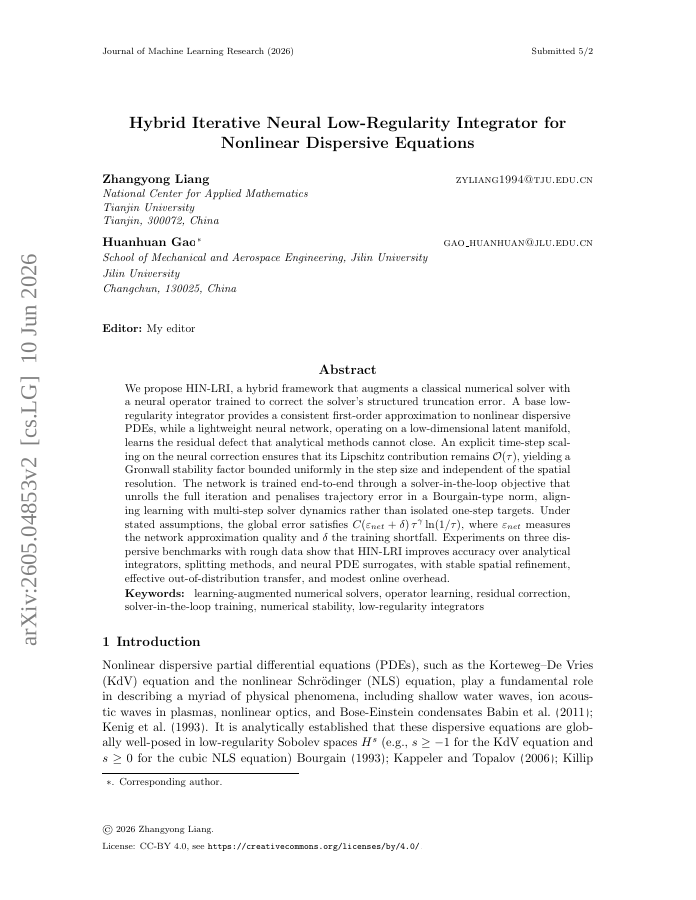
We propose HIN-LRI, a hybrid framework that augments a classical numerical solver with a neural operator trained to correct the solver's structured truncation error. A base low-regularity integrator provides a consistent first-order approximation to nonlinear dispersive PDEs, while a lightweight neural network, operating on a low-dimensional latent manifold, learns the residual defect that analytical methods cannot close. An explicit time-step scaling on the neural correction ensures that its Lipschitz contribution remains O(τ), yielding a Gronwall stability factor bounded uniformly in the step size and independent of the spatial resolution. The network is trained end-to-end through a solver-in-the-loop objective that unrolls the full iteration and penalises trajectory error in a Bourgain-type norm, aligning learning with multi-step solver dynamics rather than isolated one-step targets. Under stated assumptions, the global error satisfies C(\varepsilon_{net}+δ),τ^γ\ln(1/τ), where \varepsilon_{net} measures the network approximation quality and δ the training shortfall. Experiments on three dispersive benchmarks with rough data show that HIN-LRI improves accuracy over analytical integrators, splitting methods, and neural PDE surrogates, with stable spatial refinement, effective out-of-distribution transfer, and modest online overhead.
Hybrid Iterative Neural Low-Regularity Integrator for Nonlinear Dispersive Equations
We propose HIN-LRI, a hybrid framework that augments a classical numerical solver with a neural operator trained to correct the solver's structured truncation error. A base low-regularity integrator provides a consistent first-order approximation to nonlinear dispersive PDEs,…
- Preview
- Year
- 2026
- Hosting
- Abstract onlyARXIV-DEFAULT
Cite
Notes
Only stored in your browser.
Attribution
- Abstract & full text
- arxiv.org/abs/2605.04853ARXIV-DEFAULT
- TL;DR
- Semantic Scholar