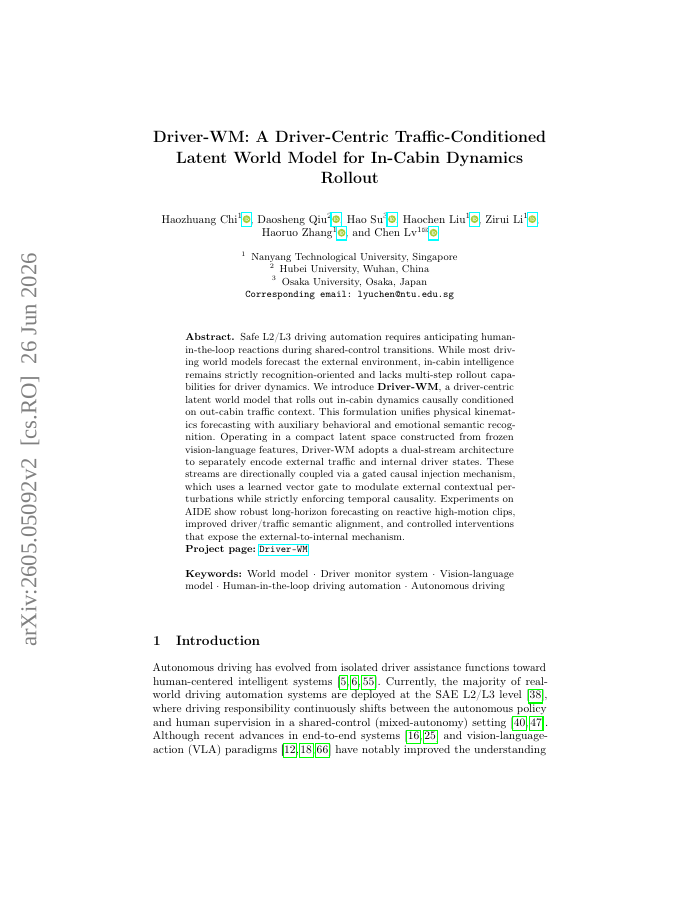
Safe L2/L3 driving automation requires anticipating human-in-the-loop reactions during shared-control transitions. While most driving world models forecast the external environment, in-cabin intelligence remains strictly recognition-oriented and lacks multi-step rollout capabilities for driver dynamics. We introduce Driver-WM, a driver-centric latent world model that rolls out in-cabin dynamics causally conditioned on out-cabin traffic context. This formulation unifies physical kinematics forecasting with auxiliary behavioral and emotional semantic recognition. Operating in a compact latent space constructed from frozen vision-language features, Driver-WM adopts a dual-stream architecture to separately encode external traffic and internal driver states. These streams are directionally coupled via a gated causal injection mechanism, which uses a learned vector gate to modulate external contextual perturbations while strictly enforcing temporal causality. Experiments on AIDE show robust long-horizon forecasting on reactive high-motion clips, improved driver/traffic semantic alignment, and controlled interventions that expose the external-to-internal mechanism.
Driver-WM: A Driver-Centric Traffic-Conditioned Latent World Model for In-Cabin Dynamics Rollout
Safe L2/L3 driving automation requires anticipating human-in-the-loop reactions during shared-control transitions. While most driving world models forecast the external environment, in-cabin intelligence remains strictly recognition-oriented and lacks multi-step rollout…
- Preview
- Year
- 2026
- Hosting
- Abstract onlyARXIV-DEFAULT
Cite
Notes
Only stored in your browser.
Attribution
- Abstract & full text
- arxiv.org/abs/2605.05092ARXIV-DEFAULT
- TL;DR
- Semantic Scholar