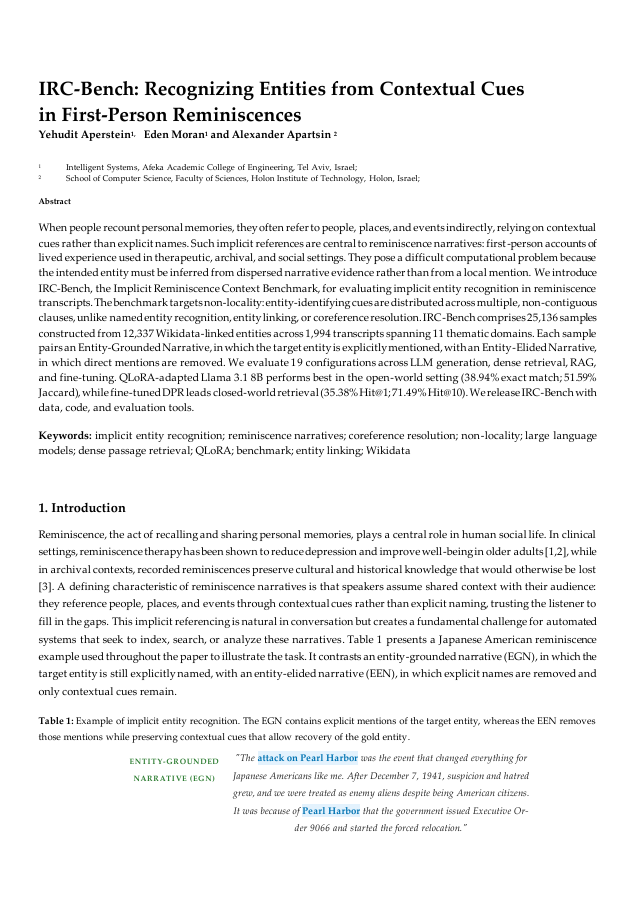
When people recount personal memories, they often refer to people, places, and events indirectly, relying on con-textual cues rather than explicit names. Such implicit references are central to reminiscence narratives: first-person accounts of lived experience used in therapeutic, archival, and social settings. They pose a difficult computational problem because the intended entity must be inferred from dispersed narrative evidence rather than from a local mention. We introduce IRC-Bench, the Implicit Reminiscence Context Benchmark, for evaluating implicit entity recognition in reminiscence transcripts. The benchmark targets non-locality: entity-identifying cues are distributed across multiple, non-contiguous clauses, unlike named entity recognition, entity linking, or coreference resolution. IRC-Bench comprises 25,136 samples constructed from 12,337 Wikidata-linked entities across 1,994 transcripts spanning 11 thematic domains. Each sample pairs an Entity-Grounded Narrative, in which the target entity is ex-plicitly mentioned, with an Entity-Elided Narrative, in which direct mentions are removed. We evaluate 19 config-urations across LLM generation, dense retrieval, RAG, and fine-tuning. QLoRA-adapted Llama 3.1 8B performs best in the open-world setting (38.94% exact match; 51.59% Jaccard), while fine-tuned DPR leads closed-world retrieval (35.38% Hit@1; 71.49% Hit@10). We release IRC-Bench with data, code, and evaluation tools.
IRC-Bench: Recognizing Entities from Contextual Cues in First-Person Reminiscences
When people recount personal memories, they often refer to people, places, and events indirectly, relying on con-textual cues rather than explicit names. Such implicit references are central to reminiscence narratives: first-person accounts of lived experience used in…
- Preview
- Year
- 2026
- Hosting
- Full text hostedCC-BY-4.0
Cite
Notes
Only stored in your browser.
Attribution
- Abstract & full text
- arxiv.org/abs/2605.06142CC-BY-4.0
- TL;DR
- Semantic Scholar